

Definitions
Deadly physical force – PL §10(11)
◦Physical force which, under the circumstances in which it is used, is readily capable of causing death or other serious physical injury.
Physical Injury – PL §10(9)
◦Impairment of physical condition or substantial pain.
Serious physical injury – PL §10(10)
Physical injury which creates a substantial risk of death, or which causes death or serious and protracted disfigurement, protracted impairment of health or protracted loss or impairment of the function of any bodily organ.
Serious Bodily Injury – Executive Law §837-t(1)(f) ***
Bodily injury that involves a substantial risk of death, unconsciousness, protracted and obvious disfigurement, or protracted loss or impairment of the function of a bodily member, organ, or mental faculty.
Objectively Reasonable
An objective standard used to judge an officer’s actions
Under this standard, a particular application of force must be judged through the perspective of a reasonable officer facing the same set of circumstances, without the benefit of 20/20 hindsight, and be based on the totality of the facts that are known to that officer at the time that the force was used
Sir Robert Peel
Peelian Principle 6 (Sir Robert Peel):
"Police use physical force only when persuasion, advice, and warning are insufficient to obtain public cooperation, and then only the minimum degree of force necessary to achieve a legitimate police objective."
Simple Summary
Police should rely on communication, persuasion, and voluntary compliance whenever possible. Force should be used only as a last resort and only to the extent necessary to safely and lawfully resolve the situation.
Key Takeaways
- Communication first – Attempt verbal direction, de-escalation, and persuasion before using force.
- Force as a last resort – Use force only when other reasonable options have failed or are not practical.
- Minimum force necessary – Apply the least amount of force needed to achieve a lawful objective.
- Proportional response – The level of force should match the threat or resistance encountered.
- Maintain public trust – Restrained and professional use of force reinforces community confidence in law enforcement.
Training-Friendly Version
"Officers should seek voluntary compliance through communication and de-escalation whenever possible. When force becomes necessary, it should be limited to the minimum amount reasonably required to achieve a lawful and safe outcome."
Use of Force Authorization
Constitutional Authority
The U.S. Constitution establishes the legal framework governing police use of force.
- The Fourth Amendment regulates force used during seizures, arrests, investigatory stops, and other encounters.
- The Fourteenth Amendment governs force involving pretrial detainees.
- The Eighth Amendment applies to convicted prisoners.
The landmark Supreme Court case Graham v. Connor established the "objective reasonableness" standard for evaluating police use of force.
New York State Law
The primary statutory authority for police use of force is found in:
- New York Penal Law Article 35
Article 35 defines when officers are legally justified in using:
- Physical force
- Deadly physical force
- Force during arrests and custody situations
Judicial Decisions
Federal and New York courts interpret constitutional and statutory requirements governing force.
Key cases include:
- Graham v. Connor – Objective reasonableness standard.
- Tennessee v. Garner – Restrictions on the use of deadly force against fleeing suspects.
New York's Police Power
Police officers exercise authority on behalf of the State of New York to protect:
- Life
- Public safety
- Public order
- Property
This authority is exercised within the limits imposed by the Constitution, state law, and department policy.
Training Summary
In New York, an officer's authority to use force is derived from the U.S. Constitution, New York Penal Law Article 35, judicial decisions, and agency policy. Any force used must be objectively reasonable, legally justified, and necessary under the circumstances known to the officer at the time.
New York Penal Law Article 35
Article 35 ("Justification") defines the circumstances under which a person, including a police officer, may legally use physical force or deadly physical force. It recognizes that force may be necessary to protect life, make arrests, prevent crimes, and maintain public safety.
Key Principles
1. Force Must Be Justified
Force is lawful only when authorized by Article 35 and when the actor reasonably believes it is necessary under the circumstances.
2. Physical Force
A police officer may use physical force when reasonably necessary to:
- Effect or attempt an arrest
- Prevent an escape from custody
- Defend themselves or others
- Perform other lawful duties
3. Deadly Physical Force
Deadly physical force may be used only under limited circumstances, including when an officer reasonably believes it is necessary to:
- Defend against the use or imminent use of deadly physical force
- Stop a person who has committed or attempted certain serious violent felonies and poses a continuing threat of death or serious physical injury
4. Reasonableness Standard
The officer's actions are judged based on what a reasonable officer would believe under the circumstances at the time, not with hindsight.
5. Protection of Life
The law emphasizes that the use of force should be directed toward protecting life and preventing serious harm whenever possible.
Law Enforcement Training Summary
New York Penal Law Article 35 authorizes police officers to use physical force and, when legally justified, deadly physical force in the performance of their duties. Any force used must be based on a reasonable belief that it is necessary under the circumstances and must comply with constitutional standards, state law, and agency policy.
One-Sentence Version
Article 35 provides the legal justification for the use of force in New York, allowing officers to use only the force they reasonably believe is necessary to accomplish a lawful objective, protect life, and ensure public safety.
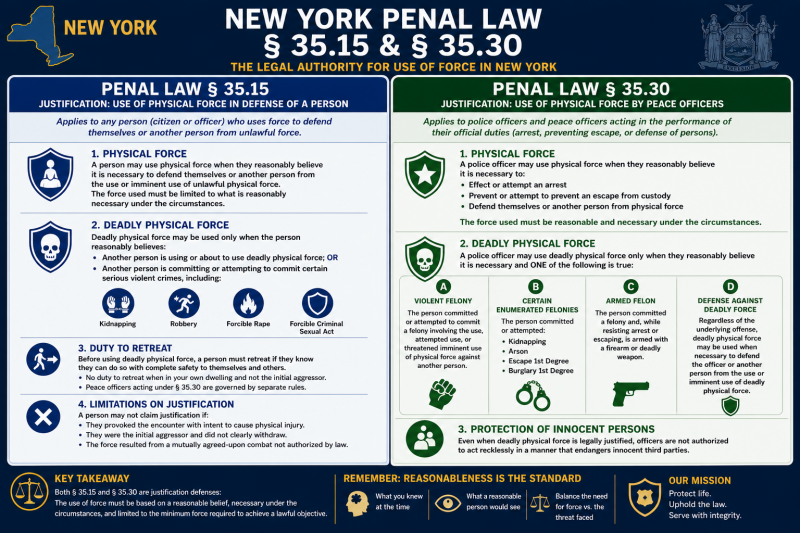
New York Penal Law § 35.15 – Justification: Use of Physical Force in Defense of a Person
Section 35.15 establishes when a person is legally justified in using physical force or deadly physical force to protect themselves or another person from unlawful force. It is the foundation of New York's self-defense law.
Key Principles
1. Physical Force
A person may use physical force when they reasonably believe it is necessary to defend themselves or another person from the use or imminent use of unlawful physical force. The force used must be limited to what is reasonably necessary under the circumstances.
2. Deadly Physical Force
Deadly physical force may be used only when a person reasonably believes:
- Another person is using or about to use deadly physical force; or
- Another person is committing or attempting to commit certain serious violent crimes, including kidnapping, robbery, or specified forcible sex offenses.
3. Duty to Retreat
Before using deadly physical force, a person generally must retreat if they know they can do so with complete safety to themselves and others. Exceptions include:
- The person is in their own dwelling and is not the initial aggressor.
- Police officers acting under the authority of § 35.30 are governed by separate provisions.
4. Limitations on Justification
A person may not claim justification if:
- They provoked the encounter with intent to cause physical injury.
- They were the initial aggressor and did not clearly withdraw from the confrontation.
- The force resulted from a mutually agreed-upon combat not authorized by law.
Training Summary
New York Penal Law § 35.15 permits a person to use reasonable physical force to defend themselves or another from unlawful force. Deadly physical force is justified only when facing a deadly threat or certain serious violent crimes, and only when no safe alternative exists. The justification defense is based on what a reasonable person would believe under the circumstances.
One-Sentence Version
Section 35.15 allows the use of force in self-defense or defense of others when reasonably necessary, while strictly limiting the use of deadly force to situations involving deadly threats or certain violent felonies.
New York Penal Law § 35.30
Section 35.30 governs when police officers and peace officers may use physical force or deadly physical force while making an arrest, preventing an escape, or defending themselves or others. It is the primary New York statute authorizing police use of force.
Key Principles
1. Physical Force
A police officer may use physical force when the officer reasonably believes it is necessary to:
- Effect or attempt an arrest
- Prevent or attempt to prevent an escape from custody
- Defend themselves or another person from physical force
The force used must be reasonable and necessary under the circumstances.
2. Deadly Physical Force
Deadly physical force may be used only when the officer reasonably believes it is necessary and one of the following conditions exists:
A. Violent Felonies
The person committed or attempted to commit a felony involving the use, attempted use, or threatened imminent use of physical force against another person.
B. Certain Enumerated Felonies
The person committed or attempted:
- Kidnapping
- Arson
- Escape in the First Degree
- Burglary in the First Degree
and deadly force is necessary to effect the arrest or prevent escape.
C. Armed Felon
The person committed a felony and, while resisting arrest or escaping, is armed with a firearm or deadly weapon.
D. Defense Against Deadly Force
Regardless of the underlying offense, deadly physical force may be used when necessary to defend the officer or another person from the use or imminent use of deadly physical force.
3. Protection of Innocent Persons
Even when deadly force is legally justified, officers are not authorized to act recklessly in a manner that endangers innocent third parties.
Training Summary
New York Penal Law § 35.30 authorizes police officers to use reasonable physical force when necessary to make an arrest, prevent an escape, or protect themselves or others. Deadly physical force is justified only under specific circumstances involving violent felonies, certain serious crimes, armed felons, or the defense of life against a deadly threat.
One-Sentence Version
Section 35.30 provides New York police officers with the legal authority to use only the force reasonably necessary to perform their duties, while strictly limiting the use of deadly physical force to situations involving serious threats to life or specifically defined violent crimes.
Tennessee v. Garner (1985) – Summary
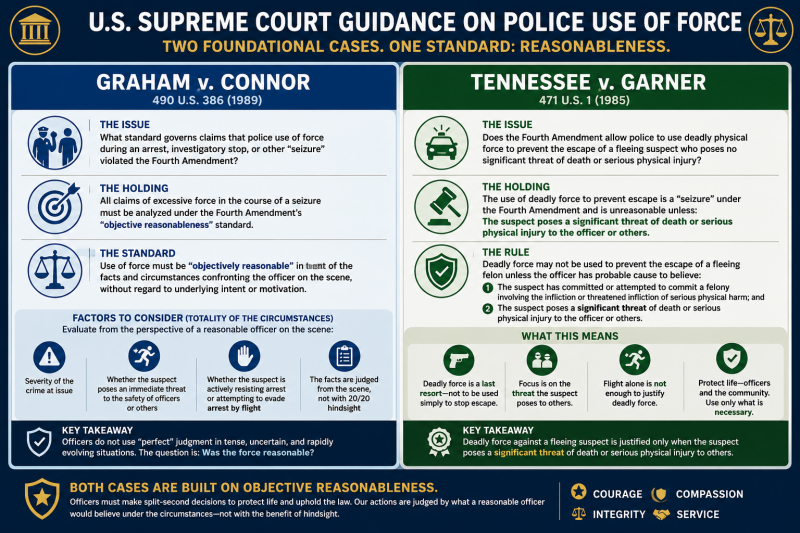
Tennessee v. Garner is the landmark U.S. Supreme Court case that established constitutional limits on the use of deadly force against fleeing suspects.
The Issue
The Court was asked:
Can a police officer use deadly force to stop any fleeing felony suspect from escaping?
The Holding
The Court ruled that the Fourth Amendment prohibits the use of deadly force against a fleeing suspect unless the officer has probable cause to believe the suspect poses a significant threat of death or serious physical injury to the officer or others.
In other words:
Flight alone does not justify deadly force.
The Rule
An officer may use deadly force to prevent escape only when:
- The suspect poses a significant threat of death or serious physical injury to the officer or others; and
- Deadly force is necessary to prevent the escape.
When feasible, the officer should identify themselves and provide a warning before using deadly force.
Key Principle
The Court balanced:
- The government's interest in apprehending suspects
- The individual's constitutional right to life and freedom from unreasonable seizure
The Court determined that the use of deadly force is a seizure under the Fourth Amendment and must therefore be reasonable.
What Tennessee v. Garner Changed
Before Garner, many states allowed officers to use deadly force against virtually any fleeing felony suspect.
After Garner:
- Deadly force cannot be used solely because a suspect is fleeing.
- The suspect must present a significant threat of death or serious physical injury.
- The use of deadly force must be objectively reasonable under the circumstances.
Impact on New York Law Enforcement
For New York officers, Tennessee v. Garner works together with:
- Graham v. Connor
- New York Penal Law § 35.30
Even if state law authorizes deadly force, the officer's actions must still satisfy the constitutional requirements established by Garner.
Training Summary
Tennessee v. Garner established that deadly force may not be used against a fleeing suspect unless the officer has probable cause to believe the suspect poses a significant threat of death or serious physical injury to the officer or others and deadly force is necessary to prevent escape.
One-Sentence Version
A suspect's flight alone does not justify deadly force; the suspect must pose a significant threat of death or serious physical injury before deadly force can be constitutionally reasonable.
Graham v. Connor (1989) – Summary
Graham v. Connor is the landmark U.S. Supreme Court case that established the constitutional standard for evaluating police use of force under the Fourth Amendment.
The Issue
The Court was asked:
What standard should be used to determine whether an officer's use of force during an arrest, investigatory stop, or other seizure is lawful?
The Holding
The Court ruled that all claims of excessive force by law enforcement during a seizure must be analyzed under the Fourth Amendment's "objective reasonableness" standard.
This means an officer's actions are judged based on what a reasonable officer would have done under the same circumstances.
Objective Reasonableness
The reasonableness of force is evaluated:
- From the perspective of a reasonable officer on the scene
- Based on the facts known to the officer at the time
- Without the benefit of hindsight
- Without regard to the officer's underlying intent or motivation
Graham Factors
The Court identified several key factors to consider:
- Severity of the crime at issue
- Whether the suspect poses an immediate threat to officers or others
- Whether the suspect is actively resisting arrest or attempting to evade arrest by flight
These are commonly called the Graham Factors.
Important Principle
The Court recognized that police officers often must make:
"split-second judgments—in circumstances that are tense, uncertain, and rapidly evolving."
Because of this, force decisions are evaluated based on the circumstances confronting the officer at the moment force was used.
Impact on New York Law Enforcement
For New York officers, every use-of-force incident must satisfy:
- Constitutional standards established by Graham v. Connor
- New York Penal Law Article 35
- Agency policy
Even when force is authorized under state law, it must still be objectively reasonable under the Fourth Amendment.
Training Summary
Graham v. Connor established that police use of force is judged by an objective reasonableness standard. Officers are evaluated based on what a reasonable officer would have done under the same circumstances, considering the facts known at the time, without hindsight.
One-Sentence Version
The question in every use-of-force encounter is not whether the officer's decision was perfect, but whether the force used was objectively reasonable under the circumstances.
Scott v. Harris (2007) – Summary
Scott v. Harris is a significant U.S. Supreme Court case addressing the use of force during vehicle pursuits and the application of the Fourth Amendment's reasonableness standard.
The Issue
The Court was asked:
Does a police officer violate the Fourth Amendment by using force to terminate a high-speed vehicle pursuit when that action creates a substantial risk of serious injury or death to the fleeing driver?
The Facts
A deputy sheriff attempted to stop a speeding vehicle. The driver, Victor Harris, fled, leading officers on a high-speed chase. To end the pursuit, an officer intentionally struck Harris's vehicle, causing it to crash and leaving Harris seriously injured.
The Holding
The Court ruled that the officer's actions were objectively reasonable under the Fourth Amendment.
The Court held that an officer may use force to terminate a dangerous vehicle pursuit when the fleeing suspect's actions pose a substantial and immediate threat to the public.
Key Principle
The Court emphasized that:
The risk of serious injury or death to innocent motorists, pedestrians, and officers can outweigh the risk posed to the fleeing suspect.
When a suspect's reckless driving creates a significant danger to the public, officers may take reasonable actions to stop the threat, even if those actions carry a risk of serious injury to the suspect.
Relationship to Graham v. Connor
Scott v. Harris applied the objective reasonableness standard established in Graham v. Connor.
The Court balanced:
- The danger posed by the fleeing suspect
- The government's interest in protecting the public
- The level of force used to stop the threat
Training Implications
Officers should consider:
- The danger posed by the suspect's driving
- Risks to innocent motorists and pedestrians
- Available alternatives
- Whether the force used is reasonable given the threat
The case does not authorize force in every vehicle pursuit. The decision depends on the totality of the circumstances and the danger created by the fleeing suspect.
Impact on New York Law Enforcement
For New York officers, pursuit-related force must satisfy:
- The Fourth Amendment's objective reasonableness standard under Graham v. Connor
- The balancing analysis of Scott v. Harris
- New York law and agency pursuit policies
Training Summary
Scott v. Harris held that an officer's use of force to terminate a dangerous vehicle pursuit may be constitutionally reasonable when the fleeing suspect's actions pose a substantial and immediate threat to public safety.
One-Sentence Version
When a fleeing driver's reckless actions endanger the public, officers may use objectively reasonable force to stop the threat, even when that force creates a risk of serious injury to the suspect.
San Francisco v. Sheehan (2015) – Summary
City and County of San Francisco v. Sheehan is an important U.S. Supreme Court case involving police use of force when dealing with a person experiencing a mental health crisis.
The Facts
Police officers responded to a group home after learning that Teresa Sheehan, a resident with a mental illness, had threatened staff members with a knife.
When officers entered her room, Sheehan threatened them with the knife. The officers withdrew but then re-entered the room. Sheehan again advanced toward the officers with the knife, and the officers shot her.
The Issue
The Court considered whether:
- Officers violated the Fourth Amendment by using force against an armed, mentally ill individual.
- The Americans with Disabilities Act (ADA) required officers to provide accommodations during the encounter.
The Holding
The Supreme Court held that the officers were entitled to qualified immunity because they did not violate clearly established law.
The Court found that officers confronted with an armed and dangerous individual are not required to delay action when faced with an immediate threat.
Key Principle
The Court reaffirmed that:
Officers may use reasonable force when confronted with an immediate threat, even when the subject is experiencing a mental health crisis.
The presence of mental illness is an important factor to consider, but it does not eliminate an officer's right to protect themselves or others from an imminent threat.
Training Implications
The case reinforces several important principles:
- Mental illness should be considered in tactical decision-making when feasible.
- De-escalation efforts should be used when circumstances permit.
- Officer and public safety remain paramount when facing an immediate threat.
- The reasonableness of force is judged based on the facts known to officers at the time.
Relationship to Graham v. Connor
Like Graham v. Connor, the case applies the objective reasonableness standard.
Factors include:
- Immediacy of the threat
- Availability of alternatives
- Risk to officers and others
- The rapidly evolving nature of the situation
Impact on New York Law Enforcement
For New York officers, the case highlights that:
- Encounters involving persons in crisis should emphasize communication and de-escalation when safe and feasible.
- Mental illness does not prevent officers from using force when necessary to address an imminent threat.
- Any force used must still be objectively reasonable under the Fourth Amendment and consistent with New York law and agency policy.
Training Summary
San Francisco v. Sheehan held that officers may use objectively reasonable force against an armed individual experiencing a mental health crisis when that person poses an immediate threat. While officers should consider de-escalation and accommodations when feasible, they are not required to endanger themselves or others by delaying action in the face of a deadly threat.
One-Sentence Version
Mental illness is a factor to consider, but it does not prevent officers from using objectively reasonable force when confronting an immediate threat to safety.