



*Refer to the Member's Manual for tactics and procedures*
Mod 11 Domestic Incidents
In New York, a “domestic incident” is a legal term defined by New York Family Court Act § 812 and related laws.
📘 Definition
A domestic incident refers to certain acts that occur between people who have a specific personal relationship, such as:
- Family members (spouses, former spouses, relatives by blood or marriage)
- People with a child in common
- People in an intimate relationship (even if not living together)
⚖️ What kinds of acts qualify?
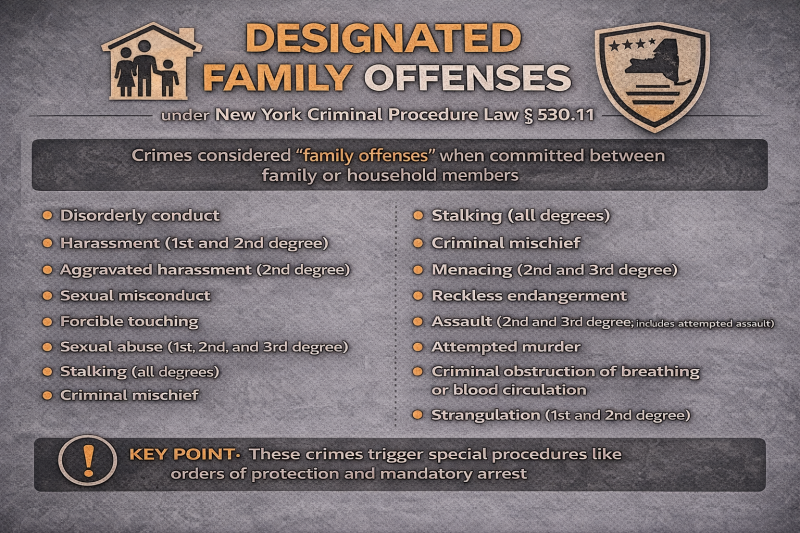
A domestic incident involves conduct that may constitute offenses like:
- Disorderly conduct
- Harassment (including aggravated harassment)
- Assault or attempted assault
- Stalking
- Menacing or reckless endangerment
- Criminal mischief
These acts are defined under the New York Penal Law.
🧾 Key point
A “domestic incident” doesn’t necessarily mean a crime has been proven—it means:
An incident involving people in a qualifying relationship where one of these offenses is alleged to have occurred.
🚔 How it’s used
Law enforcement (like the New York State Police) use the term when:
- Responding to calls involving family or intimate partners
- Filing a Domestic Incident Report (DIR)
- Determining whether special domestic violence procedures apply
Definitions
Domestic Relationship:
- A member of the same family or household
- Currently legally married
- Formerly legally married
- Related by marriage (affinity)
- Related by blood (consanguinity)
- Have a child together
- Involved in or were in intimate relationship…
Intimate Relationship:
No specific definition of “intimate relationship”
- Intimate relationship factors
- Nature and Type of relationship
- Frequency and Causation of interactions
- Duration of relationship
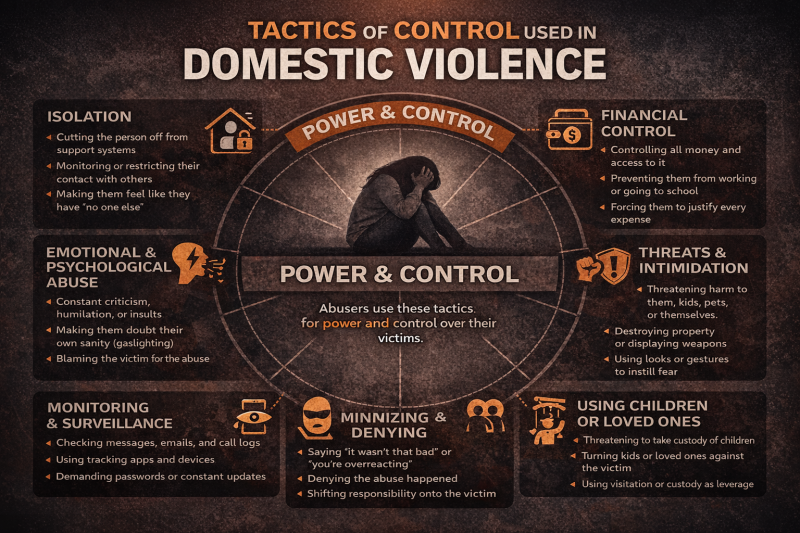
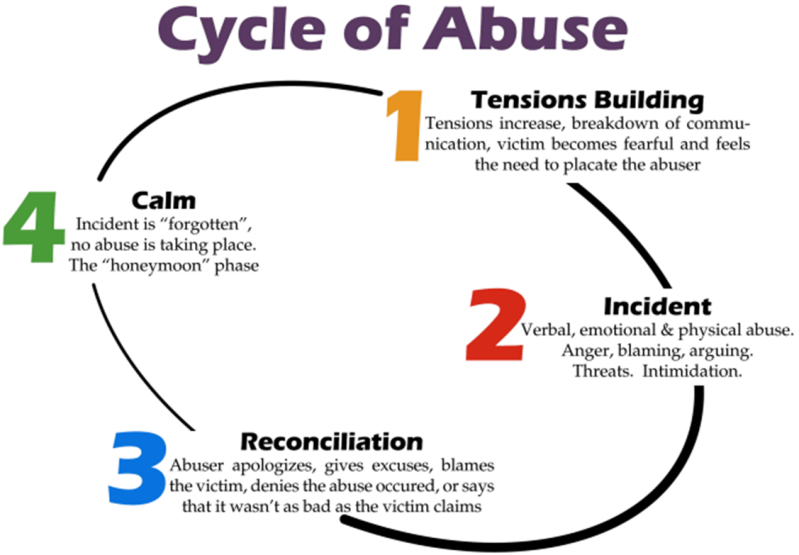
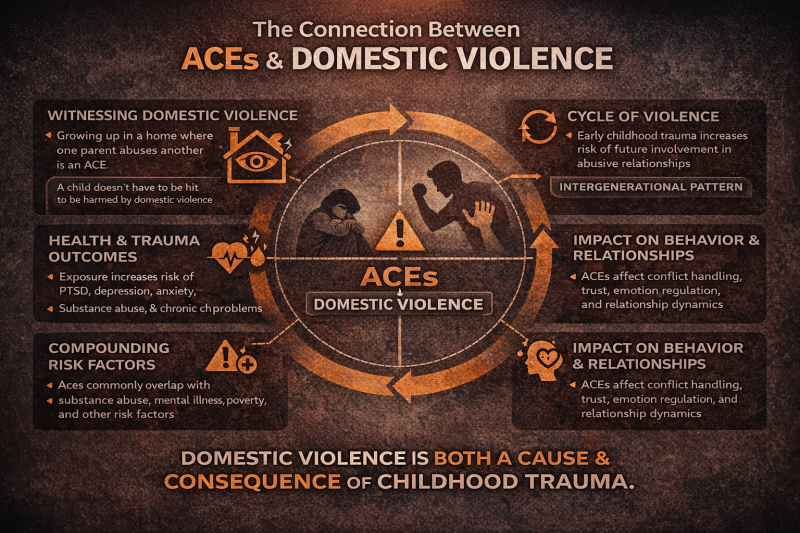
Domestic Violence:
- Has no statutory definition
- Described as pattern of coercive tactics with the goal of establishing and maintaining power and control
Two Primary Functions of Law Enforcement During a Domestic Incident
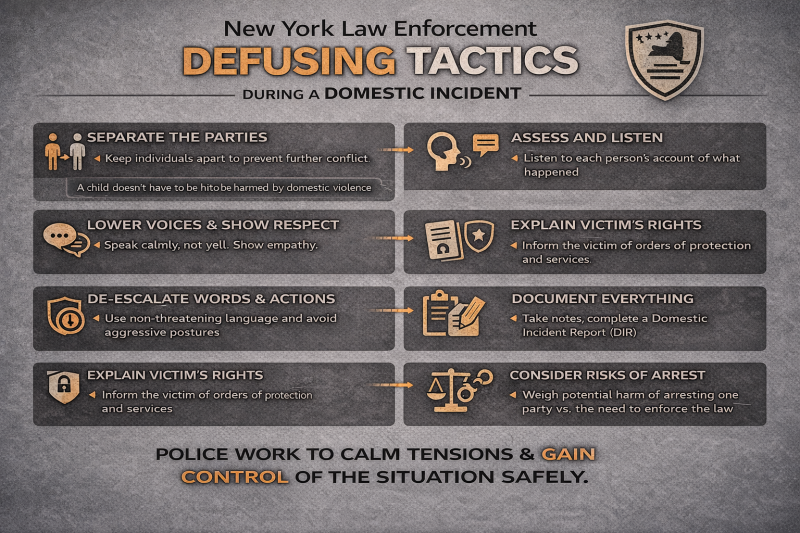
🚔 1. Protect the Victim (Safety First)
The top priority is immediate safety. Officers are required to:
- Separate the parties involved
- Assess risk of further harm
- Provide assistance (medical help, shelter info, etc.)
- Help the victim understand their rights, including orders of protection
This duty is rooted in New York’s mandatory domestic violence response policies under New York Criminal Procedure Law § 140.10.
⚖️ 2. Enforce the Law (Including Mandatory Arrest)
Police must determine whether a crime has occurred and take action, which may include:
- Mandatory arrest when there is probable cause for certain offenses (like assault or violation of an order of protection)
- Filing a Domestic Incident Report (DIR)
- Collecting evidence and documenting statements
Agencies like the New York State Police follow strict protocols to ensure consistent enforcement.
🧭 Bottom Line
Law enforcement’s role is both protective (ensuring immediate safety) and legal (investigating and enforcing the law).
New York Criminal Procedure Law § 140.10(6)
This subsection requires police to take action regarding weapons during a domestic incident.
🔫 Key Requirement: Seizure of Firearms
When officers respond to a domestic incident, they must seize firearms and other weapons if:
- There is probable cause that a crime involving a family/household member occurred, or
- They believe the weapon is likely to be used to cause harm
🚔 Scope of Authority
Police can:
- Take possession of guns, rifles, and other dangerous weapons
- Remove weapons even if they are legally owned
- Act immediately at the scene to reduce risk
⚠️ Purpose
The law is designed to:
- Prevent escalation of violence
- Protect victims and others at the scene
- Reduce the risk of serious injury or death
🧭 Bottom Line
Subsection (6) focuses on disarming potentially dangerous situations by requiring officers to remove firearms when there is a credible risk in a domestic incident.

Criminal Contempt 2nd Degree§ 215.50
🔹 Core Idea:
Violation of a lawful court order (most commonly an Order of Protection)
🔑 Key Elements:
- A valid court order exists
- The defendant knows about the order
- The defendant intentionally disobeys it
🚔 Common Examples:
- Calling or texting a protected party
- Showing up at a prohibited location
- Refusing to comply with court conditions
⚠️ Charge Level:
- Class A Misdemeanor
💡 Think:
“Did they violate the order—without physical harm required?”
Criminal Contempt 1st Degree§ 215.51
🔹 Core Idea:
More serious violation of an order—usually involving harm, threats, or weapons
🔑 Key Elements (any of the following):
- Violates an order AND causes physical injury
- Violates an order AND displays a weapon
- Engages in repeated violations (pattern of behavior)
- Strangles/chokes protected party (related elevated provisions)
🚔 Common Examples:
- Assaulting a protected party while an order is in place
- Showing a weapon during a violation
- Repeated harassment despite the order
⚠️ Charge Level:
- Felony (varies—often Class E or higher depending on subsection)
💡 Think:
“Violation + danger, harm, or escalation”
🧠 Simple Field Decision Framework
Step 1: Is there a valid Order of Protection?
Step 2: Does the suspect know about it?
Step 3: Did they violate it?
👉 If YES → Contempt 2nd
👉 Then ask:
- Injury?
- Weapon?
- Repeated behavior?
👉 If YES → Contempt 1st
🚨 Key Teaching Point for Recruits
- 2nd Degree = violation alone
- 1st Degree = violation + aggravating factor
🧩 Common Mistakes
- Not confirming the order is valid and in effect
- Failing to prove knowledge of the order
- Missing escalation factors (injury, weapon, pattern)
🔥 Quick Scenario Example
Subject texts protected party → Contempt 2nd
Subject punches protected party → Contempt 1st
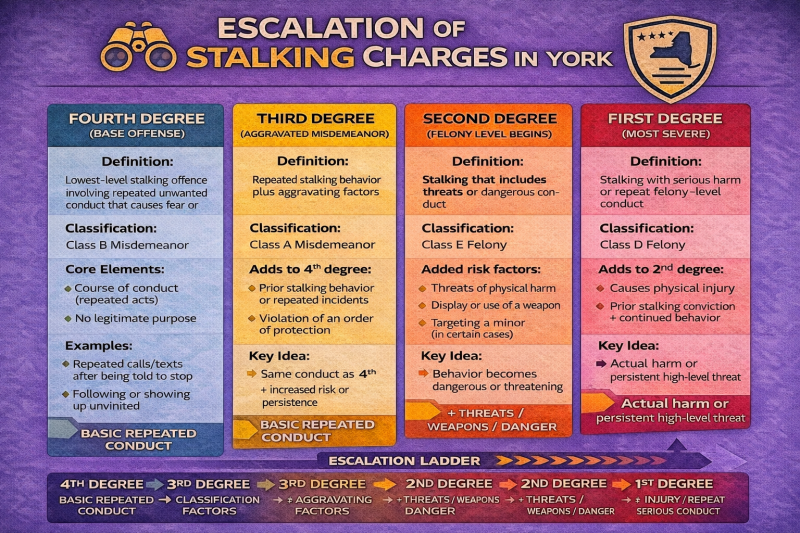
Stalking 4th Degree § 120.45
🔹 Core Idea:
Repeated unwanted conduct that causes fear or harm
🔑 Key Elements:
- Intentional course of conduct (more than one act)
- Directed at a specific person
- Causes:
- Fear of harm OR
- Material harm to mental/emotional health
🚔 Common Examples:
- Repeated following
- Constant unwanted messages
- Showing up at home/work repeatedly
⚠️ Charge Level:
- Class B Misdemeanor
💡 Think:
“Pattern of behavior causing fear”
Stalking 3rd Degree § 120.50
🔹 Core Idea:
Escalated stalking behavior or prior history
🔑 Key Elements (any of these):
- Prior stalking conviction
- Targets multiple victims
- Conduct violates an Order of Protection
- Repeated acts causing reasonable fear
⚠️ Charge Level:
- Class A Misdemeanor
💡 Think:
“Stalking + aggravating factor (history, multiple victims, or OP violation)”
Stalking 2nd Degree § 120.55
🔹 Core Idea:
Stalking with threats or weapon involvement
🔑 Key Elements:
- Course of conduct AND:
- Threats of harm OR
- Displays/uses a weapon
- Causes fear of serious injury
🚔 Examples:
- Following someone while making threats
- Showing a weapon during stalking behavior
⚠️ Charge Level:
- Class E Felony
💡 Think:
“Stalking + threats or weapon = felony”
Stalking 1st Degree § 120.60
🔹 Core Idea:
Stalking that results in actual harm
🔑 Key Elements:
- Stalking behavior AND:
- Causes physical injury to victim
⚠️ Charge Level:
- Class D Felony
💡 Think:
“Stalking + actual injury”
🧠 Simple Charge Selection Framework
Step 1: Is there a course of conduct (pattern)?
➡️ NO → Not stalking
➡️ YES → Continue
Step 2: Does it cause fear or emotional harm?
➡️ YES → Stalking 4th
⬇️ Escalate if:
- Prior conviction / multiple victims / OP violation → 3rd
- Threats or weapon → 2nd
- Physical injury → 1st
🚨 Key Teaching Points
- Stalking requires a pattern (not a single act)
- Victim fear must be reasonable
- Documentation of timeline of events is critical
🧩 Common Mistakes
- Charging stalking on a single incident
- Failing to document multiple acts
- Missing escalation factors (threats, OP violation)
🔥 Quick Scenario Ladder
- Repeated unwanted texts causing fear → 4th
- Same + Order of Protection → 3rd
- Same + threats (“I’m going to hurt you”) → 2nd
- Same + actual assault → 1st
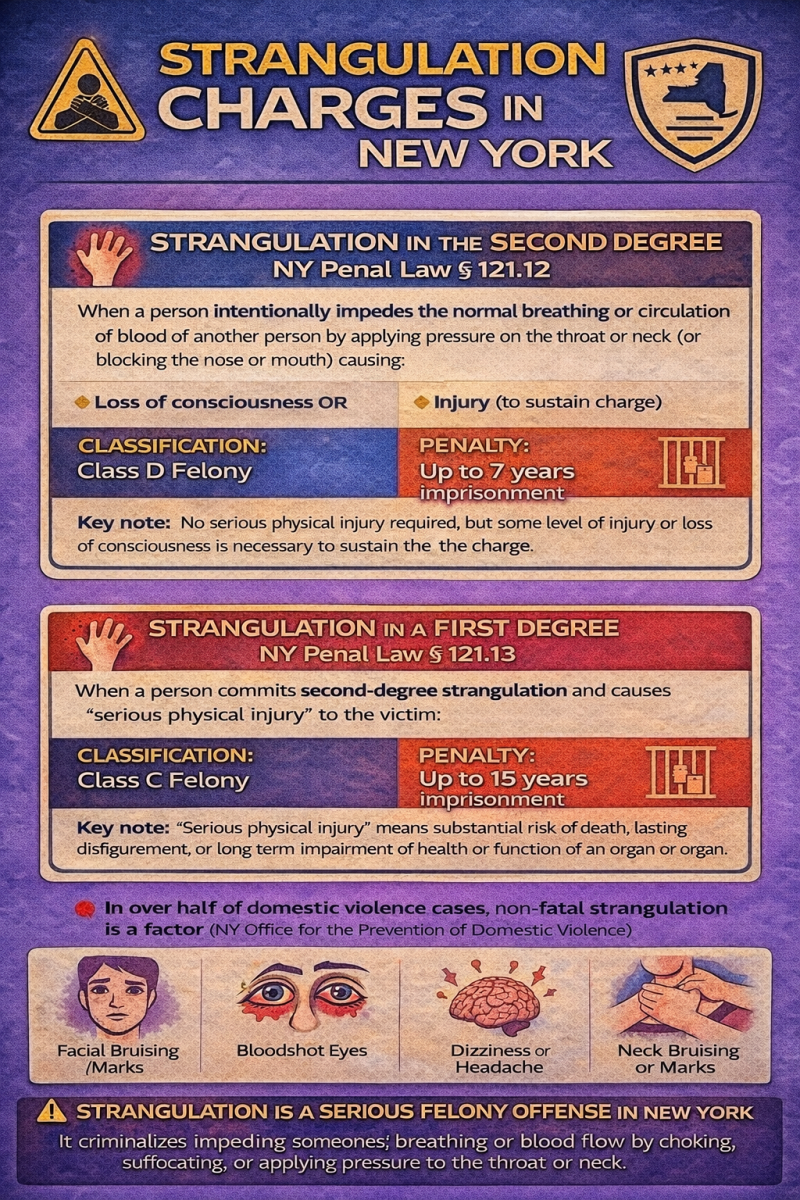
Strangulation 2nd Degree § 121.12
🔹 Core Idea:
Applying pressure to the throat/neck (or blocking breathing) and causing injury
🔑 Key Elements:
- Intentional:
- Impeding normal breathing or circulation
- By:
- Applying pressure to throat/neck OR
- Blocking nose/mouth
- AND causes:
- Physical injury (pain, impairment)
OR - Stupor / loss of consciousness
- Physical injury (pain, impairment)
🚔 What Officers Look For:
- Victim reports:
- “I couldn’t breathe”
- “I almost passed out”
- Physical signs:
- Redness, marks, swelling
- Voice changes
- Behavioral signs:
- Panic, dizziness
⚠️ Charge Level:
- Class D Violent Felony
💡 Think:
“They restricted breathing AND it caused injury or impairment”
Strangulation 1st Degree § 121.13
🔹 Core Idea:
Strangulation that causes serious injury or is especially dangerous
🔑 Key Elements:
All elements of 2nd degree PLUS one of the following:
- Causes serious physical injury
- Causes brain injury
- Occurs under circumstances showing extreme indifference to human life
🚔 Examples:
- Victim loses consciousness and suffers lasting injury
- Severe oxygen deprivation leading to neurological issues
- Prolonged choking with high risk of death
⚠️ Charge Level:
- Class C Violent Felony
💡 Think:
“Strangulation + serious harm or life-threatening conduct”
🧠 Simple Field Decision Framework
Step 1: Was breathing or circulation restricted?
⬇️
Step 2: Was there injury or impairment?
➡️ YES → Strangulation 2nd
⬇️
Step 3: Was there serious injury or extreme danger?
➡️ YES → Strangulation 1st
🚨 Key Teaching Points
- Visible injury is NOT always required initially—victim statements matter
- Strangulation is high-risk for delayed death or serious complications
- Always treat as a serious assaultive offense
🧩 Common Mistakes
- Treating it as simple harassment or assault
- Failing to document:
- Breathing restriction
- Victim statements (“I couldn’t breathe”)
- Missing escalation to 1st degree when serious injury exists
Endangering the Welfare of a Child - §260.10
A person is guilty of Endangering the Welfare of a Child when they knowingly act in a way that is likely to harm the physical, mental, or moral welfare of a child under 17 years old.
Key Elements
A person commits this offense when they:
-
Act in a manner likely to be injurious to a child’s physical, mental, or moral welfare, or
-
Direct or allow a child to engage in dangerous or illegal activity, or
-
As a parent/guardian, fail to exercise reasonable diligence to control a child who becomes a juvenile delinquent or person in need of supervision (PINS).
Important Points
-
The child must be under 17 years old.
-
The defendant must knowingly engage in the conduct that creates the risk of harm.
-
Actual injury does not have to occur — the risk of harm is sufficient.
Common Examples
-
Driving while intoxicated with a child in the vehicle
-
Leaving a child in dangerous conditions
-
Exposing a child to drug use or criminal activity
-
Allowing a child to engage in dangerous or illegal behavior
Unlawfully Dealing with a Child 2nd Degree§ 260.21
🔹 Core Idea:
Providing prohibited items (alcohol/tobacco) to minors
🔑 Key Elements:
- Defendant knowingly:
- Gives, sells, or allows consumption of:
- Tobacco products
- Marks with a tattoo
- Gives, sells, or allows consumption of:
- To a person under 18 (tobacco)
🚔 Common Examples:
- Adult buys cigarettes for underage individuals
- Allowed in a place where alcohol is served
- Selling vape/tobacco to a minor
⚠️ Charge Level:
- Class B Misdemeanor
💡 Think:
“Adult provides alcohol/tobacco to a minor”
Unlawfully Dealing with a Child 1st Degree § 260.20
🔹 Core Idea:
Acting in a way that is harmful to a child’s welfare
🔑 Key Elements:
- Defendant knowingly acts in a manner likely to be injurious to:
- Physical, mental, or moral welfare of a child (<17)
🚔 Common Examples:
- Allowing drug use around children
- Exposing child to criminal activity
- Leaving a child in dangerous conditions
- Encouraging illegal behavior
- Sexual activity occurring
⚠️ Charge Level:
- Class A Misdemeanor
💡 Think:
“Behavior that harms or risks harming a child”
🧠 Simple Field Decision Framework
Step 1: Is this about alcohol/tobacco to a minor?
➡️ YES → 2nd Degree
⬇️
Step 2: Is the conduct broader and harmful to a child’s welfare?
➡️ YES → 1st Degree
🚨 Key Teaching Points
- 1st Degree is broader and more serious
- 2nd Degree is specific to alcohol/tobacco
- Focus on what is “likely to be injurious” (not just actual harm)
🧩 Common Mistakes
- Charging 2nd degree when conduct supports 1st degree
- Not documenting why the conduct is harmful
- Missing environmental factors (drugs, unsafe conditions)
🔥 Quick Scenario Examples
- Adult buys beer for 19-year-old → 2nd Degree
- Adult uses drugs in front of child → 1st Degree
- Parent leaves child in unsafe environment → 1st Degree