

Constitutional Law
The “Payton rule” refers to a constitutional principle established by the U.S. Supreme Court in Payton v. New York (445 U.S. 573, 1980). Although it’s a federal constitutional rule and not a specific New York statute, it originated out of a case involving New York law and therefore often gets discussed in the context of New York search-and-seizure law.
Core of the Payton Rule
-
Warrant Requirement for Home Arrests: Police may not enter a person’s home to make a routine felony arrest without a warrant just because they have probable cause. This protects the Fourth Amendment right against unreasonable searches and seizures.
-
The rationale is that a person’s home enjoys special protection under the Fourth Amendment — crossing the threshold without judicial authorization is constitutionally prohibited absent an exception.
-
Exceptions
There are a few situations where police can enter without a warrant:
-
Exigent circumstances: Emergencies such as hot pursuit of a fleeing suspect, imminent destruction of evidence, or an immediate threat to safety may justify warrantless entry.
-
Consent: If someone with authority voluntarily allows the officers in, no warrant is needed.
⚖️ Scope and Impact
-
The Payton rule applies to arrests — it doesn’t by itself authorize a search of the home for evidence. A separate warrant or exception would be needed for that.
-
It affects how police execute arrest warrants in domestic settings, shaping procedures for law enforcement and how courts assess evidence obtained after a questionable entry.
In short, under the Payton rule police generally need a valid arrest warrant to enter a residence to arrest someone — unless exigent circumstances or valid consent exist.
Penal Law § 220.25(1) — Automobile Presumption
Case Law Snapshot
🔹 Statutory Rule
The presence of a controlled substance in an automobile is presumptive evidence of knowing possession by all occupants, subject to enumerated exceptions.
This is a permissive presumption, not mandatory.
⚖️ Leading Court of Appeals Cases
🔹 People v. Leyva, 38 N.Y.2d 160 (1975)
-
Upheld constitutionality of the automobile presumption.
-
Held it is a permissive inference, not burden-shifting.
-
There must be a rational connection between the proven fact (drugs in car) and inferred fact (knowing possession).
📌 Key Takeaway: Presumption survives constitutional attack if rational under the circumstances.
🔹 People v. Reisman, 29 N.Y.2d 278 (1971)
-
Clarified constructive possession principles.
-
Mere presence is insufficient absent presumption.
-
Reinforced dominion and control analysis.
📌 Key Takeaway: Outside the statutory presumption, presence alone is not enough.
🔹 People v. Lemmons, 40 N.Y.2d 505 (1976)
-
Addressed limits of presumptions generally.
-
Reinforced that presumption must be supported by a logical relationship.
📌 Key Takeaway: Presumption cannot be arbitrary.
🚘 Application & Limitation Cases
🔹 Exclusive Possession Exception
Presumption does not apply where:
-
Drugs are found on one occupant’s person.
-
Drugs are found in a container under one occupant’s exclusive control.
Courts frequently analyze:
-
Whose bag?
-
Whose pocket?
-
Locked glove compartment?
-
Statements indicating ownership?
🔹 Hired Vehicle Exception
Passengers in:
-
Taxicabs
-
Buses
-
Certain hired vehicles
Often exempt from presumption unless facts show dominion/control.
🔹 Visibility & Location Factors
Courts look at:
-
Open view vs. concealed
-
Proximity to each occupant
-
Whether drugs were accessible
-
Statements or behavior (furtive movements, admissions)
The presumption is weaker where:
-
Drugs are hidden in trunk
-
Rear-seat passenger with no access
-
Large multi-passenger vehicle
🧠 Constitutional Standard
Under due process:
-
There must be a rational connection between presence in car and knowledge.
-
Jury must be instructed that presumption is permissive.
-
Burden of proof remains on the People.
Improper jury instructions can be reversible error.
People v. Davis, 75 N.Y.2d 517 (1990) – Summary
Key Holding:
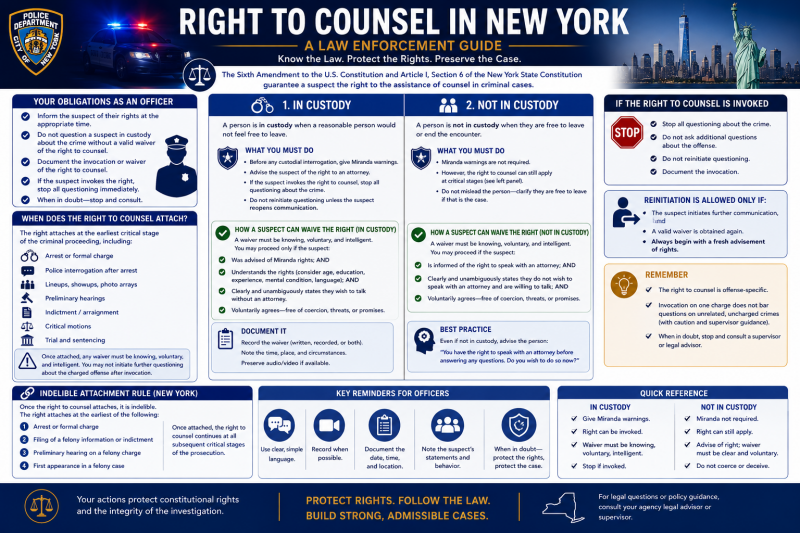
The People v. Davis (1990) decision clarified that New York's indelible right to counsel is not permanent. Once the attorney-client relationship ends, a defendant may again validly waive the right to counsel and speak with police, provided the waiver is knowing, intelligent, and voluntary.
Facts
- Defendant had previously been represented by counsel on a criminal matter.
- That attorney-client relationship later ended.
- Police subsequently questioned the defendant without counsel present.
- The issue before the Court was whether the previous attachment of the right to counsel permanently prohibited police questioning.
Court's Decision
The Court of Appeals held that:
- The indelible right to counsel protects an existing attorney-client relationship, not one that has already ended.
- When representation has terminated, the defendant is no longer insulated from police questioning.
- Police may obtain a valid waiver of Miranda rights if no attorney currently represents the defendant on that matter.
Important Principles for Law Enforcement
✅ The indelible right to counsel does not last forever.
A suspect may waive the right to counsel when:
- Representation has legitimately ended.
- The attorney-client relationship no longer exists.
- The waiver is knowing, intelligent, and voluntary after proper advisement.
A suspect may not waive the right to counsel when:
- Counsel currently represents the suspect on that criminal matter.
- The right has attached and the attorney-client relationship remains intact.
- Police initiate questioning without counsel present.
Why the Case Matters
People v. Davis established that New York's indelible right to counsel is tied to an active attorney-client relationship, not simply the historical fact that counsel once appeared. It prevents police from interfering with an ongoing representation but does not permanently bar future questioning after representation has lawfully ended.
Training Takeaway
Rule: The indelible right to counsel protects an existing attorney-client relationship. If representation has ended, police may seek a new waiver. If representation is ongoing, police-initiated interrogation without counsel is prohibited.
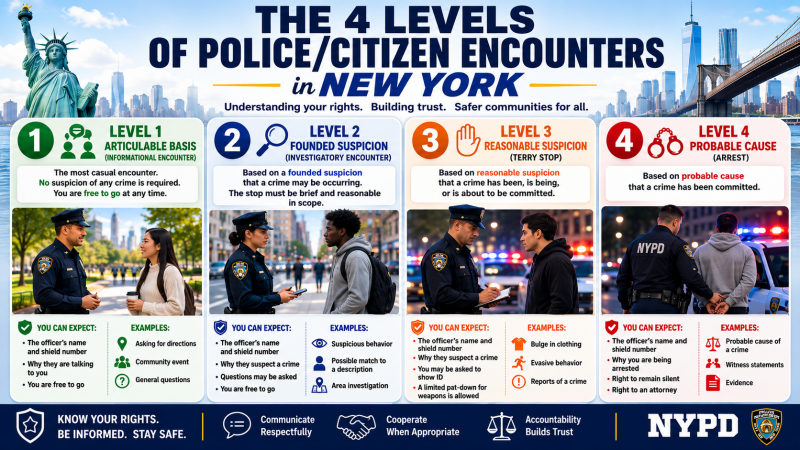
Probable Cause Under CPL 70.10(2):
Reasonable cause to believe that a person has committed an offense exists when evidence or information which appears reliable discloses facts or circumstances that are collectively of such weight and persuasiveness as to convince a person of ordinary intelligence, judgment, and experience that it is reasonably likely that the offense was committed and that such person committed it.
Frisk/Pat Down
Under New York law, a frisk is:
A limited pat-down of a person's outer clothing conducted by a police officer to determine whether the person is armed with a deadly weapon or other instrument capable of causing serious physical injury, when the officer reasonably suspects that the person is armed and presently dangerous.
Legal Standard
A frisk is authorized under New York's common law and CPL 140.50(3) after a lawful Level 3 encounter (Reasonable Suspicion), when the officer:
- Has lawfully stopped the person, and
- Reasonably suspects the person is armed and poses a danger to the officer or others.
Important Points
- A frisk is not automatic during every stop.
- Its purpose is officer safety, not to search for evidence.
- It is generally limited to a pat-down of the outer clothing.
- If the officer feels an object whose contour or mass reasonably indicates it is a weapon, the officer may retrieve it.
- If no facts support a reasonable belief the person is armed and dangerous, a frisk is not justified simply because a stop occurred.
Academy Definition
Frisk: A limited protective pat-down of the outer clothing of a lawfully stopped person to determine whether the person possesses a weapon, conducted only when the officer has reasonable suspicion that the person is armed and presently dangerous.
This is the definition commonly taught in New York police academies and is consistent with CPL 140.50(3) and the standards established by the courts following the principles of Terry v. Ohio.