Mod 10 Crimes Against Property
SESSION 1 Trespass and Criminal Trespass
SESSION 2 Computer Trespass and Tampering
SESSION 3 Criminal Mischief
SESSION 4 Burglary
SESSION 5 Building Searches
SESSION 6 Larceny
SESSION 7 Other Theft Offenses
SESSION 8 Arson
SESSION 9 Forgery
SESSION 10 Other Fraud Offenses

Trespass and Criminal Trespass
DEFINITIONS: 140.00 (1)
“Premises” includes the term “building” as defined herein, and any real property
“Building” in addition to its ordinary meaning, includes any structure, vehicle or watercraft used for overnight lodging of persons, or used by persons for carrying on business therein, or used as an elementary or secondary school, or an enclosed motor truck, or an enclosed motor truck trailer. Where a building consists of two or more units separately secured or occupied, each unit shall be deemed both a separate building in itself and a part of the main building
“Dwelling” means a building which is usually occupied by a person lodging therein at night
Trespass – § 140.05
Violation (not a crime)
-
Knowingly enters or remains unlawfully on premises.
-
Covers basic unauthorized entry (e.g., staying after being told to leave).
Criminal Trespass in the Third Degree – § 140.10
New York Penal Law § 140.10 – Criminal Trespass in the Third Degree is a Class B misdemeanor.
Basic Summary
A person is guilty of Criminal Trespass in the Third Degree when they knowingly enter or remain unlawfully in certain types of property. The key element is that the person knows they do not have permission to be there.
Common Situations Covered
Under § 140.10, this typically includes:
-
Fenced or enclosed property
– Entering or staying on property that is fenced or otherwise enclosed in a way meant to exclude intruders. -
School grounds
– Entering or remaining unlawfully on school property (with some statutory exceptions). -
Public housing property
– Entering or remaining unlawfully in a public housing project. -
Railroad yards
– Entering or remaining unlawfully in a railroad yard. -
Possession of certain weapons on school grounds
– Unlawfully entering or remaining on school grounds while knowingly possessing certain weapons (this elevates seriousness within the subsection).
Key Elements the Prosecution Must Prove
-
The defendant entered or remained unlawfully, and
-
The defendant did so knowingly (aware they did not have license or privilege).
Criminal Trespass in the Second Degree – § 140.15
New York Penal Law § 140.15 – Criminal Trespass in the Second Degree is a Class A misdemeanor and is more serious than third-degree trespass.
Basic Summary
A person is guilty of Criminal Trespass in the Second Degree when they knowingly enter or remain unlawfully in a dwelling.
Key Points
-
“Dwelling” means a building that is usually occupied by someone lodging there at night (e.g., a house or apartment).
-
The person must know they do not have permission (no license or privilege) to enter or stay.
-
Unlike burglary, no intent to commit a crime inside is required — just unlawful entry or remaining in a dwelling.
Elements the Prosecution Must Prove
-
The location was a dwelling,
-
The defendant entered or remained unlawfully, and
-
The defendant did so knowingly.
Criminal Trespass in the First Degree – § 140.17
New York Penal Law § 140.17 – Criminal Trespass in the First Degree is a Class D felony and is the most serious trespass offense under Article 140 (short of burglary).
Basic Summary
A person is guilty of Criminal Trespass in the First Degree when they:
-
Knowingly enter or remain unlawfully in a dwelling, and
-
While doing so, possess:
-
An explosive, or
-
A deadly weapon.
-
Key Elements
To convict, the prosecution must prove:
-
The location was a dwelling (a place normally used for overnight lodging),
-
The defendant knowingly entered or remained unlawfully, and
-
At the time of the unlawful presence, the defendant possessed a deadly weapon or explosive.
Important Distinction
-
Unlike burglary, first-degree criminal trespass does not require intent to commit a crime inside.
-
The felony level is based on the added danger created by possessing a weapon or explosive while unlawfully inside a dwelling.
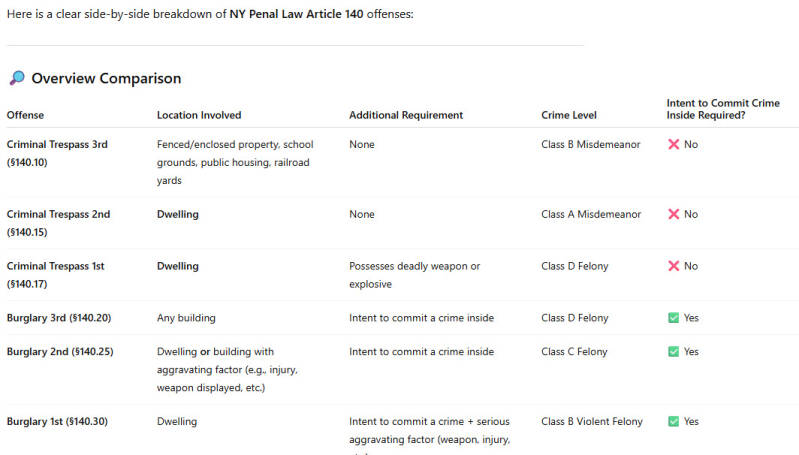

Burglary in the Third Degree - § 140.20
Burglary in the Third Degree is a Class D felony.
Basic Definition
A person is guilty of Burglary in the Third Degree when they:
Knowingly enter or remain unlawfully in a building with intent to commit a crime therein.
Key Elements the Prosecution Must Prove
-
The defendant knowingly entered or remained unlawfully,
-
The location was a building, and
-
At the time of entry or unlawful remaining, the defendant had the intent to commit a crime inside.
Important Points
-
The crime intended inside does not have to be theft — it can be any crime (e.g., assault, criminal mischief, etc.).
-
The intended crime does not have to be completed — intent alone is sufficient.
-
A “building” includes structures such as stores, offices, warehouses, and in some circumstances vehicles or watercraft used for overnight lodging or business.
-
Unlike Burglary 2nd or 1st, no dwelling requirement or aggravating factor (like weapons or injury) is necessary.
Burglary in the Second Degree - § 140.25
Burglary in the Second Degree is a Class C felony (and in most circumstances involving a dwelling, it is classified as a violent felony offense).
Basic Definition
A person is guilty of Burglary in the Second Degree when they:
Knowingly enter or remain unlawfully in a building with intent to commit a crime therein,
and one of the following aggravating factors is present:
Aggravating Factors
While in the building (or in immediate flight):
-
They are armed with explosives or a deadly weapon, or
-
They cause physical injury to a non-participant, or
-
They use or threaten the immediate use of a dangerous instrument, or
-
They display what appears to be a firearm,
OR
-
The building is a dwelling (a place normally used for overnight lodging).
Key Points
-
The intended crime inside can be any crime (it does not have to be completed).
-
If the location is a dwelling, the charge qualifies as Burglary 2nd even without a weapon or injury.
-
When based on a dwelling, it is typically treated as a violent felony offense under NY law.
Burglary in the First Degree - § 140.30
Burglary in the First Degree is a Class B violent felony offense, the most serious burglary charge under Article 140.
Basic Definition
A person is guilty of Burglary in the First Degree when they:
Knowingly enter or remain unlawfully in a dwelling with intent to commit a crime therein,
and one of the following aggravating factors is present.
Required Elements
-
The location is a dwelling (a place normally used for overnight lodging),
-
The defendant knowingly entered or remained unlawfully,
-
The defendant had intent to commit a crime inside, and
-
While in the dwelling (or in immediate flight), the defendant:
-
Is armed with explosives or a deadly weapon, or
-
Causes physical injury to a non-participant, or
-
Uses or threatens the immediate use of a dangerous instrument, or
-
Displays what appears to be a firearm.
-
Key Points
-
The intended crime inside does not need to be completed.
-
The aggravating factor must occur during the burglary or immediate flight.
-
This charge reflects the heightened danger of a forced intrusion into someone’s home combined with violence or weapons.

Criminal Mischief in the Fourth Degree § 145.00
Here’s a plain-English summary:
1. Intentionally damages the property of another
2. Intentionally participates in the destruction of an abandoned building
3.Recklessly damages property over $250
4. Intentionally damage communication devices to prevent a call for help
Level of offense:
-
It is a Class A Misdemeanor
Criminal Mischief in the Third Degree § 145.05
Here’s a plain-English summary:
What it means:
You commit this offense if you intentionally damage someone else’s property and:
-
The damage exceeds $250, or
-
Break into a locked vehicle causing damage to same and you have a prior criminal mischief conviction within the past 10 years.
Level of offense:
-
It is a Class E felony (more serious than lower degrees).
Criminal Mischief in the Second Degree § 145.10
-
What it is: A person commits this offense when they intentionally damage someone else’s property and the damage exceeds $1,500.
-
Level: Class D felony (serious property crime).
-
Key element: Prosecutors must prove the damage was intentional, not accidental.
- Plain English: It’s charged when someone deliberately causes significant property damage above the felony threshold.
Criminal Mischief in the first Degree § 145.12
-
What it is: A person commits this offense when they intentionally damage another person’s property by using an explosive, and the damage is substantial.
-
Level: Class B violent felony (one of the most serious property crimes in NY).
-
Key elements prosecutors must prove:
-
Intentional damage
-
Use of an explosive device
- Plain English: It’s the top level of criminal mischief — deliberately blowing up or using explosives to damage property.
-

Larceny Defined:
Stealing property
Depriving another of property
Wrongfully takes, obtains, or withholds property
Methods
Obtaining property by trick, embezzlement or false pretenses
Acquiring lost property
Issuing a bad check
Obtaining property by false promise
Promising future action that is never going to happen
Wage theft
Deed theft
EXTORTION
Make another deliver property by means of causing fear that if it is not delivered:
Physical injury will occur to another in the future
Property will be damaged
False accusations of crime will be made
Secret will be exposed (does not have to be true)
Cause a strike
Testify or withhold testimony
Use/Abuse position as public servant
Perform some act that would harm another person materially

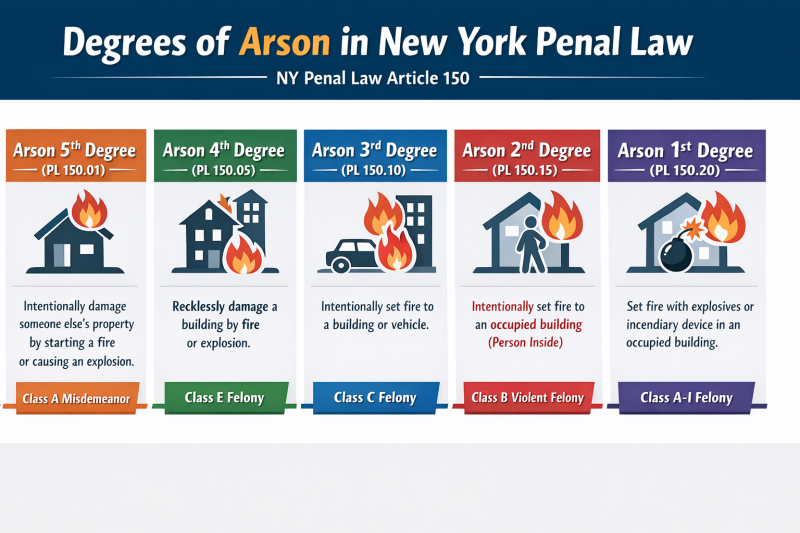
Arson in the Fifth Degree § 150.01
A person is guilty of Arson in the Fifth Degree when:
They intentionally damage property (any property, not just buildings or vehicles) by starting a fire or causing an explosion.
Key Elements
The prosecution must prove:
-
Intentional conduct – The person deliberately started the fire or caused the explosion.
-
Damage – Property was actually damaged.
-
Property – Can be any property (real or personal), not limited to buildings or cars.
Important Points
-
No requirement that the fire be large or that anyone be injured.
-
Even relatively minor property damage can qualify.
Arson in the Fourth Degree § 150.05
A person is guilty of Arson in the Fourth Degree when:
They recklessly damage a building or motor vehicle by intentionally starting a fire or causing an explosion.
Elements the Prosecution Must Prove
-
Intent – The defendant deliberately started a fire or caused an explosion.
-
Damage – A building or motor vehicle was actually damaged.
-
Property Type – The property was:
-
A building (any structure, including dwellings, commercial buildings, sheds, etc.), or
-
A motor vehicle
-
Important Points
-
The building or vehicle does not need to be occupied.
-
No person has to be injured.
-
The statute focuses on the type of property (building or vehicle), which elevates it above fifth-degree arson.
Arson in the Third Degree § 150.10
Arson in the Third Degree under New York Penal Law § 150.10 occurs when a person:
-
Intentionally damages a building or motor vehicle
-
By starting a fire or causing an explosion
Key Elements
To prove this crime, prosecutors must show that the defendant:
-
Started a fire or caused an explosion
-
Did so intentionally
-
Damaged a building or motor vehicle
Important Notes
-
No requirement that the building be occupied.
-
No requirement that someone be injured.
-
The property can belong to the defendant or another person, but certain insurance-fraud situations may also apply.
- In simple terms:
Third-degree arson = intentionally setting a fire or explosion that damages a building or vehicle.
Arson in the Second Degree § 150.15
Arson in the Second Degree under New York Penal Law § 150.15 occurs when a person:
-
Intentionally damages a building
-
By starting a fire or causing an explosion
-
While another person is present inside the building, and
-
The defendant knows that fact or the circumstances make the presence of a person reasonably possible
Key Elements Prosecutors Must Prove
-
The defendant started a fire or caused an explosion.
-
The act was intentional.
-
The fire or explosion damaged a building.
-
Another person was present in the building at the time.
-
The defendant knew or reasonably should have known someone might be inside.
Important Points
-
The person inside does not have to be injured.
-
The defendant does not need to intend harm to a person—only the fire.
-
The building can belong to the defendant or someone else.
Arson in the First Degree § 150.20
Arson in the First Degree under New York Penal Law § 150.20 occurs when a person:
-
Intentionally damages a building
-
By starting a fire or causing an explosion
-
Another person is present in the building, and
-
The defendant knows or should reasonably know that someone is inside, and
-
The defendant uses or places an explosive or incendiary device (or intends to use one) in connection with the fire.
Key Elements Prosecutors Must Prove
-
The defendant intentionally started a fire or caused an explosion.
-
The fire or explosion damaged a building.
-
Another person was present in the building at the time.
-
The defendant knew or reasonably should have known someone might be inside.
-
The defendant used or placed an explosive or incendiary device, or intended to use one.
Important Points
-
Actual injury to a person is not required.
-
The focus is on the extreme danger created by the device and occupied building.
-
It is the most serious arson charge under New York law.

Unauthorized Use of a Computer § 156.05
What it covers:
This law makes it a crime to use a computer, computer system, or network without permission.
Key element:
-
A person knowingly uses or accesses a computer or network without authorization.
👉 Unlike more serious computer crimes, this statute does NOT require damage, theft, or intent to commit another crime — just unauthorized use is enough.
Examples:
-
Logging into someone else’s account without permission
-
Accessing a restricted database you’re not allowed to use
-
Using a company system after access has been revoked
-
Bypassing login controls to explore a network
Penalty:
-
⚖️ Class A misdemeanor (up to 364 days jail, probation, fines).
Big picture:
This is the baseline New York “hacking” offense, often charged when there’s unauthorized access but no provable damage or additional crime.
Computer Trespass § 156.10
What it covers:
NY Penal Law 156.10 defines computer trespass, which involves unlawfully accessing a computer system and committing or attempting another crime while doing so.
Key elements prosecutors must prove:
A person is guilty if they:
-
Knowingly use a computer, computer service, or network without authorization, and
-
Intend to commit or attempt to commitany FELONY
-
Knowingly gain access to computer material
Important distinction:
Simply accessing a system without permission may fall under unauthorized use of a computer (PL 156.05) — computer trespass is more serious because it requires intent to commit an additional offense.
Penalty level:
-
Classified as a Class E felony in New York (potential prison, probation, fines, and a felony record).
Big picture:
The statute targets hacking or unauthorized access where the access is used as a tool to carry out another criminal act.
Computer Tampering in the Fourth Degree § 156.20
What it covers:
NY Penal Law 156.20 defines computer tampering in the fourth degree, which involves knowingly and without authorization altering or interfering with computer data or systems.
Key ways the offense can occur:
A person is guilty if they knowingly use a computer or network without authorization and:
-
Alter, destroy, delete, or modify computer data or programs, or
-
Disrupt or degrade computer services or system operations, or
-
Introduce harmful elements (like malware) that interfere with normal functioning.
Mental state:
The conduct must be knowing and without permission.
Penalty level:
-
Classified as a Class A misdemeanor in New York (potential jail up to 364 days, probation, fines).
Big picture:
This statute targets lower-level system interference — such as unauthorized changes, minor disruptions, or introducing harmful code — without requiring major damage or financial thresholds (which appear in higher degrees like 156.25, 156.26, 156.27).
Computer Tampering in the Third Degree § 156.25
What it covers:
NY Penal Law 156.25 defines computer tampering in the third degree, which is a more serious form of unauthorized interference with computer data or systems.
Key elements:
A person is guilty if they:
Commit computer tampering 4th (as defined in § 156.20 — unauthorized alteration, deletion, disruption, etc.), and
-
intent to commit a FELONY
- Cause damage exceeding $1,000.
- Intentionally destroys or alters computer material
- Previous conviction of this article or Theft of Services 165.15 sub 11 avoid payment
Mental state:
The conduct must be knowing and without authorization.
Penalty level:
-
Classified as a Class E felony in New York (potential prison, probation, fines, and a felony record).
Big picture:
This statute elevates computer tampering to a felony when the unauthorized interference results in measurable financial loss above the statutory threshold.
Computer Tampering in the Second Degree § 156.26
What it covers:
NY Penal Law 156.26 defines computer tampering in the second degree, which involves more serious unauthorized interference with computer systems that causes significant harm.
Key ways the offense can occur:
A person is guilty if they commit computer tampering (unauthorized alteration, deletion, disruption, etc.) and:
-
Cause damage exceeding $3,000, or
-
Intentionally alter or destroy computer data or programs, or
-
Disrupt or degrade computer services related to medical history or treatment which causes serious physical injury.
(Note: The statute focuses on more serious or intentional harm compared to lower degrees.)
Mental state:
Typically requires knowing and intentional conduct without authorization.
Penalty level:
-
Classified as a Class D felony in New York (potential prison, probation, fines).
Big picture:
This statute targets significant or deliberate system interference — for example, intentionally deleting important data or causing meaningful operational disruption.
Computer Tampering in the First Degree§ 156.27
What it covers:
NY Penal Law 156.27 defines the most serious level of computer tampering, involving unauthorized interference with computer systems that results in very large losses or serious harm.
Key elements:
A person is guilty if they commit computer tampering and:
-
Cause damage exceeding $50,000, or
-
Cause or create a risk of serious physical injury, or
-
Cause a substantial interruption or impairment of essential public services or infrastructure (such as utilities, transportation, or emergency systems).
Mental state:
The conduct must be knowing and without authorization, with serious consequences resulting.
Penalty level:
-
Classified as a Class C felony in New York (significant prison exposure, probation, fines).
Big picture:
This statute is aimed at high-impact cyber incidents — for example, attacks that cripple critical infrastructure, cause major financial damage, or endanger public safety.

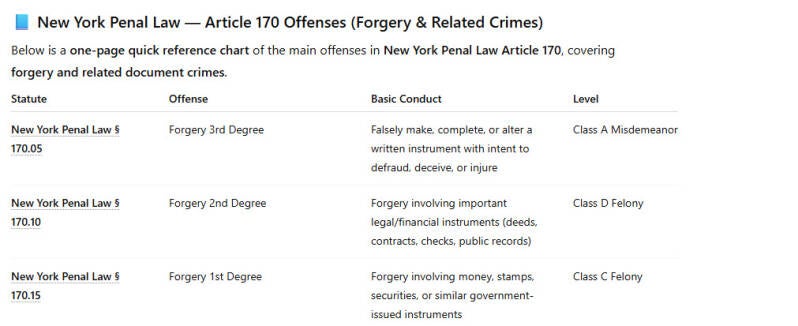
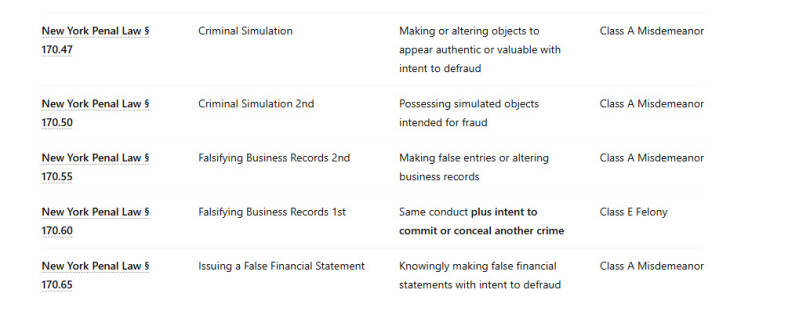
Forgery in the Third Degree § 170.05
A person commits Forgery 3rd Degree when they:
-
Falsely make, complete, or alter a written instrument, and
-
Do so with intent to defraud, deceive, or injure another person.
Examples
-
Signing someone else’s name on a document
-
Altering a receipt or contract
Level: Class A Misdemeanor
Forgery in the Second Degree § 170.10
Forgery becomes Second Degree when the forged instrument is particularly important or valuable.
Examples of instruments covered:
-
Deeds or wills
-
Contracts
-
Commercial instruments (checks, credit instruments)
-
Public records
- Drug prescriptions
Level: Class D Felony
Forgery in the First Degree § 170.15
The most serious forgery charge occurs when the forged instrument is money or financial securities, such as:
-
Currency
-
Stamps
-
Bonds
-
Other government-issued securities
Level: Class C Felony


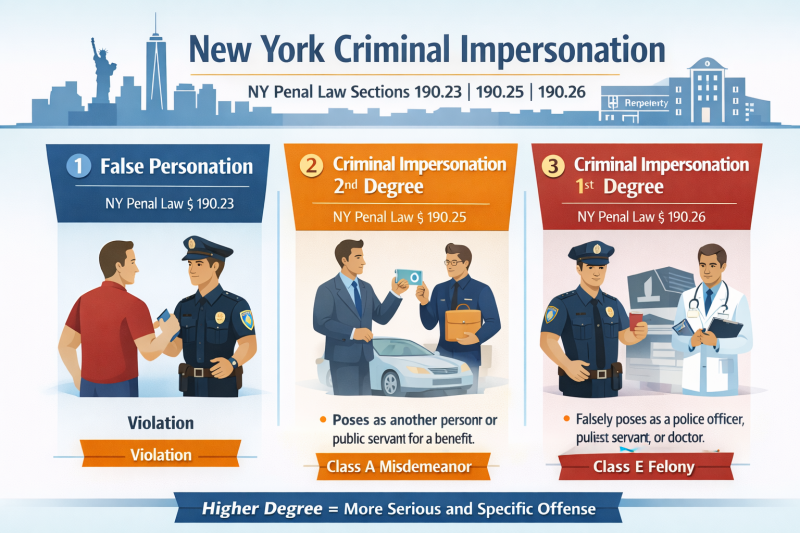
False Personation § 190.23
A person is guilty of False Personation when they:
-
After being informed of the consequences,
-
Knowingly misrepresent their actual name, date of birth, or address,
-
To a police officer or peace officer,
-
With the intent to prevent the officer from discovering information about them.
Key Elements
-
The person is questioned by a police officer or peace officer.
-
The officer warns the person that providing false information is a crime.
-
The person knowingly gives false identifying information (name, DOB, or address).
-
The person acts to avoid identification or discovery of information.
Important Points
-
The warning by the officer is required for the charge.
-
The false information typically involves identity information such as:
-
Name
-
Date of birth
-
Address
-
-
This offense commonly arises during investigations, traffic stops, or arrests.
- Simple takeaway:
§190.23 = lying about your identity to a police or peace officer after being warned that doing so is a crime.
Criminal Impersonation in the Second Degree § 190.25
A person commits Criminal Impersonation in the Second Degree when they pretend to be another person or a public servant and act in that assumed identity with intent to obtain a benefit or to injure or defraud another person.
Key Ways the Crime Can Occur
A person is guilty when they:
-
Impersonate another person and do an act in that assumed identity to obtain a benefit or harm/defraud someone.
-
Pretend to be a public servant (such as a police officer) and act as if they hold that position.
-
Pretend to represent a person or organization and act in that role with intent to defraud.
Important Points
-
The offense requires both impersonation and an act performed in that role.
-
The impersonation may involve:
-
Another real person, or
-
A public official or government authority.
-
Examples
-
Pretending to be a police officer to obtain money or compliance.
-
Using someone else’s identity during a transaction.
-
Claiming to represent a government agency to deceive someone.
Criminal Impersonation in the First Degree § 190.26
A person is guilty of Criminal Impersonation in the First Degree when they:
-
Pretend to be a police officer, peace officer, public servant, or licensed physician, and
-
Act in that assumed capacity,
-
With intent to induce another person to submit to that authority or rely on that representation.
Key Elements
-
The defendant falsely represents themselves as:
-
A police officer,
-
Peace officer,
-
Public official/servant, or
-
Licensed physician.
-
-
The defendant performs an act in that role.
-
The act is done to make another person submit to the authority or rely on the representation.
Examples
-
Pretending to be a police officer during a traffic stop.
-
Claiming to be a doctor to examine or treat someone.
-
Acting as a government official to obtain compliance or information.
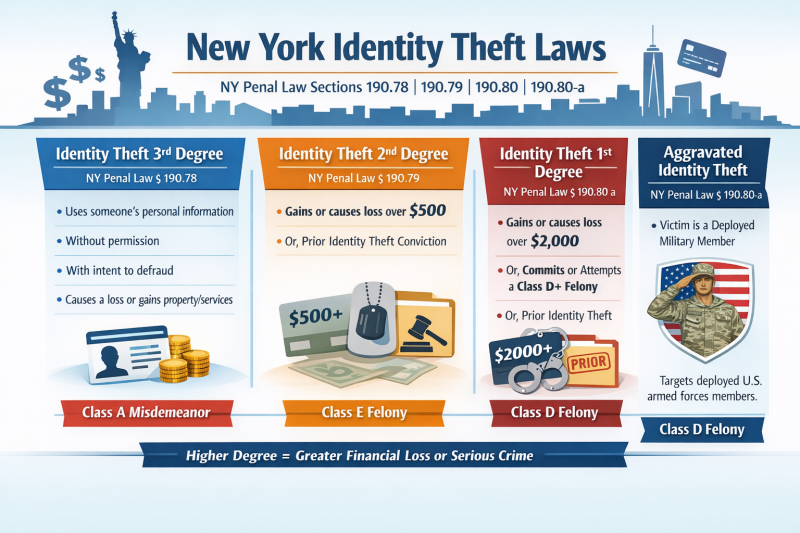
Identity Theft in the Third Degree § 190.78
A person commits Identity Theft in the Third Degree when they:
-
Knowingly use another person’s identifying information,
-
Without that person’s permission,
-
With intent to defraud, and
-
Obtain goods, money, property, or services, or cause financial loss to that person or another person.
Key Elements
-
The person uses another individual’s personal identifying information.
-
The information is used without permission.
-
The person acts with intent to defraud.
-
The act results in:
-
Obtaining money, property, goods, or services, or
-
Causing financial loss.
-
5. The person commits Class A misdemeanor or higher using another person’s identifying information
Examples
-
Using someone else's credit card number to make purchases.
-
Opening an online account using another person's identity.
-
Using someone’s Social Security number to obtain services or benefits.
What Counts as Identifying Information
Examples include:
-
Name
-
Social Security number
-
Credit/debit card number
-
Bank account number
-
Date of birth
-
Driver’s license number
Identity Theft in the Second Degree § 190.79
A person commits Identity Theft in the Second Degree when they knowingly use another person’s identifying information without permission, with intent to defraud, and one of the following occurs:
Key Circumstances
-
The person obtains goods, money, property, or services and the value exceeds $500, or
-
The act causes financial loss greater than $500, or
- The person acts an accessory or commits or attempts to commit a felony using another person’s identifying information
-
The person commits Identity Theft in the Third Degree and has a prior conviction for Identity Theft within the previous five years,
Key Elements
-
Use of another person’s identifying information
-
Without permission
-
Intent to defraud
-
Financial gain, financial loss, or qualifying circumstance
Examples
-
Using someone’s credit card information to purchase items worth more than $500.
-
Opening accounts using another person’s Social Security number, causing significant financial loss.
-
Targeting the identity of a deployed service member.
Identity Theft in the First Degree § 190.80
A person commits Identity Theft in the First Degree when they knowingly use another person’s identifying information without permission, with intent to defraud, and one of the following occurs:
Key Circumstances
-
The person obtains goods, money, property, or services and the value exceeds $2,000, or
-
The act causes financial loss greater than $2,000, or
- The person commits or attempts to commit a Class D felony or higher using another person’s identifying information
-
The person commits Identity Theft in the Second Degree and has a prior conviction for Identity Theft within the previous five years.
Key Elements
-
Use of another person’s identifying information
-
Without permission
-
Intent to defraud
-
Significant financial gain or loss
Examples
-
Using stolen credit card or banking information to make purchases exceeding $2,000.
-
Opening multiple accounts using another person’s Social Security number, causing major financial loss.
Aggravated Identity Theft § 190.80-a
A person commits Aggravated Identity Theft when they:
-
Knowingly use another person’s identifying information,
-
Without permission,
-
With intent to defraud, and
-
The victim is a member of the United States armed forces currently deployed overseas.
Important Points
-
This law enhances identity theft protections for deployed service members.
-
It applies because deployed individuals are often unable to monitor their finances or credit activity.
Classification
-
Class D Felony
Related Identity Theft Statutes
-
New York Penal Law § 190.78 — Identity Theft 3rd Degree: basic identity theft offense.
-
New York Penal Law § 190.79 — Identity Theft 2nd Degree: involves $500+ loss/gain or other aggravating circumstances.
-
New York Penal Law § 190.80 — Identity Theft 1st Degree: involves $2,000+ loss/gain, felony use of identity, or repeat identity theft.