Mod 6 Crimes Against People

Assault in the Third Degree - §120.00
New York Penal Law § 120.00 defines Assault in the Third Degree, the lowest level of assault under Article 120 of the Penal Law. A person is guilty of this offense when:
-
Intentional Injury – With intent to cause physical injury to another person, he or she causes such injury; or
-
Reckless Injury – He or she recklessly causes physical injury to another person; or
-
Criminal Negligence with a Weapon – With criminal negligence, he or she causes physical injury to another person by means of a deadly weapon or dangerous instrument.
“Physical injury” under New York law generally means impairment of physical condition or substantial pain.
Assault in the Third Degree is classified as a Class A misdemeanor, punishable by up to one year in jail, probation, fines, or a combination of penalties. It may also carry orders of protection or other collateral consequences.
Assault in the Second Degree §120.05
New York Penal Law § 120.05 defines Assault in the Second Degree, a more serious felony-level assault offense involving intentional or particularly harmful conduct.
A person is guilty of Assault in the Second Degree when he or she causes serious physical injury or physical injury under specific aggravating circumstances, including but not limited to:
-
Intentional serious physical injury to another person.
-
Intentional physical injury by means of a deadly weapon or dangerous instrument.
-
Assault with intent to prevent a police officer, peace officer, firefighter, emergency medical personnel, teacher, or other protected public servant from performing lawful duties.
-
Causing injury to certain protected individuals (including children or vulnerable persons) under specified circumstances.
-
Drugging another person without consent and causing injury.
“Serious physical injury” generally means an injury that creates a substantial risk of death, causes death, or results in serious and protracted disfigurement, impairment of health, or loss/impairment of a bodily organ.
Assault in the First Degree §120.10
Assault in the First Degree is one of the most serious assault charges in New York. It involves intentionally or recklessly causing serious physical injury under specific aggravating circumstances.
A person is guilty when they:
-
Intentional Serious Injury with a Deadly Weapon
-
Intend to cause serious physical injury to another person, and
-
Cause serious physical injury,
-
By means of a deadly weapon or dangerous instrument
-
-
Intent to Disfigure or Disable
Intend to permanently disfigure, amputate, or permanently disable a body part,-
And cause such injury.
-
-
Depraved Indifference / Reckless Conduct
-
Under circumstances showing depraved indifference to human life,
-
Recklessly engage in conduct that creates a grave risk of death,
-
And cause serious physical injury.
-
-
Felony-Related Injury
-
During the commission or attempted commission of a felony (or immediate flight),
-
Cause serious physical injury to a non-participant.
-
Key Legal Definitions
-
Serious Physical Injury: Injury that creates a substantial risk of death, causes death, or results in serious and protracted disfigurement, impairment of health, or loss of bodily function.
-
Deadly Weapon: Firearm, knife, metal knuckles, etc.
-
Dangerous Instrument: Any object capable of causing serious injury under the circumstances used.

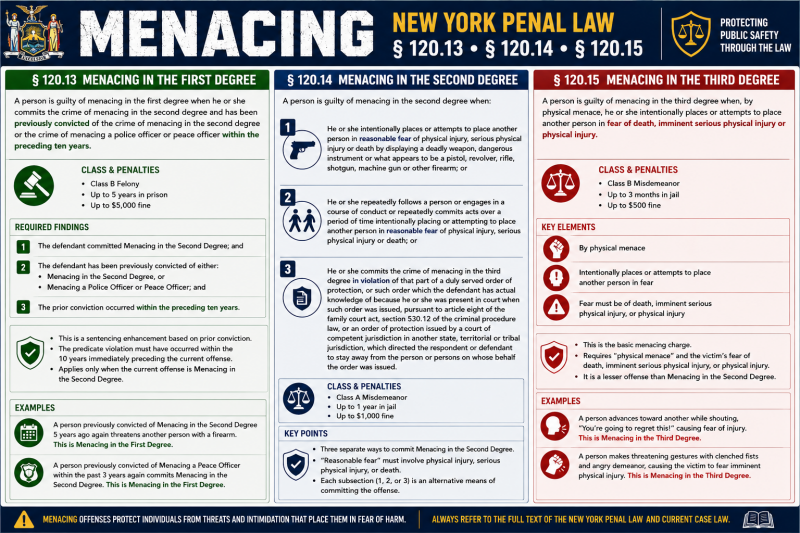
Menacing
Menacing in the Third Degree §120.15
What it covers:
This statute makes it a crime to intentionally place or attempt to place another person in fear of physical injury, death, or imminent harm through threatening conduct.
Core Elements
A person is guilty when they:
-
Intentionally engage in conduct, AND
-
Place or attempt to place another person in fear of physical injury, serious injury, or death
No weapon is required — the focus is on creating fear through behavior.
Mental State
-
Requires intent to cause fear — accidental conduct does not qualify.
In Plain English
It covers threatening behavior that makes someone reasonably afraid they’re about to be harmed, even if no physical contact occurs.
Menacing in the Second Degree §120.14
What it covers:
This statute elevates menacing when a person uses a weapon, dangerous instrument, or certain threatening conduct to place another in fear of injury or death.
Main Ways the Offense Can Occur
A person is guilty when they:
Displays a Weapon or Dangerous Instrument
-
Intentionally place or attempt to place another person in reasonable fear of physical injury, serious injury, or death,
-
By displaying a deadly weapon, dangerous instrument, or what appears to be a firearm.
Repeated Threatening Conduct (Stalking-Type Behavior)
-
Repeatedly follow or engage in conduct,
-
Intentionally placing another person in reasonable fear of physical injury.
-
Violation of an Order of Protection
-
Commit menacing conduct in violation of an order of protection.
-
Mental State
-
Requires intent to place the victim in fear.
In Plain English
It involves more serious threats, especially when a weapon is shown, the behavior is repeated, or there’s a protective order involved.
Menacing in the First Degree §120.13
What it covers:
This is the most serious menacing charge. It applies when someone intentionally places another person in fear of serious physical injury or death while displaying a weapon and has a prior qualifying conviction.
Core Elements
A person is guilty when they:
-
Intentionally place or attempt to place another person in reasonable fear of:
-
Serious physical injury, or
-
Death, AND
-
-
Display a deadly weapon, dangerous instrument, or what appears to be a firearm, AND
-
Have a prior conviction for:
-
Menacing (within a specified period), or
-
Certain related offenses (as defined by statute)
-
Mental State
-
Requires intent to cause fear — not accidental conduct.
In Plain English
It’s felony menacing — threatening someone with a weapon after already having a relevant prior conviction, showing an increased risk of dangerous behavior.
Sex Offenses
§ 130.05 Sex offenses; lack of consent
- Whether or not specifically stated, it is an element of every offense defined in this article that the sexual act was committed without consent of the victim.
- Lack of consent results from:
(a) Forcible compulsion; or
(b) Incapacity to consent; or
(c) Where the offense charged is sexual abuse or forcible touching, any circumstances, in addition to forcible compulsion or incapacity to
consent, in which the victim does not expressly or impliedly acquiesce in the actor's conduct; or
(d) Where the offense charged is rape in the third degree as defined in subdivision seven, eight or nine of section 130.25, or a crime formerly defined in subdivision three of section 130.40, in addition to forcible compulsion, circumstances under which, at the time of the act
of vaginal sexual contact, oral sexual contact or anal sexual contact, the victim clearly expressed that he or she did not consent to engage in
such act, and a reasonable person in the actor's situation would have understood such person's words and acts as an expression of lack of
consent to such act under all the circumstances.
Sexual Misconduct §130.20
A person is guilty of sexual misconduct when:
1. He or she engages in vaginal sexual contact with another person without such person's consent; or
2. He or she engages in oral sexual contact with another person without such person's consent; or
3. He or she engages in anal sexual contact with another person without such person's consent; or
4. He or she engages in sexual conduct with an animal or a dead human body.
Sexual misconduct is a class A misdemeanor.
Key Definitions
-
Without consent means the other person did not willingly agree to the contact under the law’s definitions of consent.
-
Sexual contact refers to intentional touching for the purpose of sexual gratification or abuse. The statute uses “vaginal, oral, or anal contact/conduct” to describe specific acts.
-
Important Notes
-
This is a less serious offense compared with felony sex crimes (like rape or sexual abuse in higher degrees).
-
It encompasses unwanted sexual contact as well as prohibited acts with animals or dead bodies.
-
Rape in the first degree §130.35
-
Occurs when a person engages in sexual intercourse with another person and:
-
Uses forcible compulsion, or
-
The victim is incapable of consent due to incapacity from drugs, alcohol, or mental incapacity, or
-
The victim is less than 11 years old, or
-
The actor is 21 and the victim is less than 13.
-
Rape in the second degree §130.30
-
A person is guilty of rape in the second degree when they engage in sexual intercourse with another person under certain circumstances:
-
Age-based conduct:
-
Being 18 years old or more, the defendant engages in vaginal, oral, or anal sexual intercourse with a person less than 15 years old.
-
There is an affirmative defense if the defendant was less than four years older than the victim at the time of the act for these age-based subsections.
-
-
Incapacity to consent:
-
The defendant engages in vaginal, oral, or anal sexual intercourse with someone who is incapable of consenting because of mental disability or mental incapacitation.
-
Consent and Incapacity
-
Sexual intercourse means penetration of the penis into the vagina or anus (as defined elsewhere in the statute and case law).
-
A person who is mentally disabled or incapacitated is legally incapable of consenting to the act.
-
Key Points
-
This statute focuses on serious sexual intercourse offenses involving a very young victim or someone legally unable to consent because of mental incapacity.
-
The affirmative defense for age-based conduct (victim under 15) applies only if the age difference is less than four years, which can affect sentencing or prosecution.
-
-
Rape in the third Degree §130.25
-
A person is guilty of rape in the third degree when they engage in sexual intercourse (vaginal, oral, or anal sexual contact) with another person under any of these circumstances:
-
The other person is incapable of consenting due to a factor other than being under age 17 (for example, mental disability, intoxication, physical helplessness, etc.).
-
The actor is 21 years old or older, and the other person is under 17 years old, regardless of whether the younger person appears to consent.
-
The actor engages in the intercourse without the other person’s consent where that lack of consent is due to some factor other than incapacity to consent (such as express refusal or resistance).
Note: The statute covers sexual intercourse defined as contact between the penis and vagina or anus (or oral contact with those intimate parts)
-
-
Key Legal Points
-
The statute focuses on the absence of consent or incapacity to consent rather than the level of force used.
-
Being 21 or older and engaging in intercourse with someone under 17 automatically satisfies the offense’s age-based element, even if the younger person appears willing.
-
Lack of consent can be established by testimony that the other person did not agree to the act and under applicable definitions if a reasonable person would have understood that lack of consent.
-

Forcible Touching §130.52
Under New York Penal Law § 130.52, a person is guilty of forcible touching when they:
-
Intentionally and without any legitimate purpose
forcibly touch the sexual or other intimate parts of another person for the purpose of degrading or abusing that person, or for the purpose of gratifying the actor’s sexual desire; or v -
Subject another person to sexual contact with the purpose of sexual gratification and intent to degrade or abuse, while that person is a passenger on a bus, train, or subway operated by a transit agency authorized by New York State.
What “Forcible Touching” Means
-
The term “forcible touching” includes actions like squeezing, grabbing, or pinching someone’s sexual or other intimate parts.
-
The offense requires that the contact be made without the other person’s consent (typically implicit in the “no legitimate purpose” language).
Classification and Penalty
-
Forcible touching is a Class A misdemeanor in New York.
Class A misdemeanors can carry up to one year in jail, fines, probation, and other consequences. (Penalties are determined in sentencing guidelines.)
Key Points
-
This offense focuses on sexual contact that is unwanted and intentional, even if the contact might seem minor compared with more serious sex crimes.
-
It is often charged in situations like unwanted touching in public settings (e.g., on transit), but it can also apply in other contexts where the contact is intentional and without a legitimate purpose.
Sexual abuse in the third degree §130.55
Under NY Penal Law § 130.55, a person is guilty of sexual abuse in the third degree when they subject another person to “sexual contact” without that person’s consent.
-
Sexual contact generally means intentional touching of the sexual or other intimate parts of another person for the purpose of sexual gratification, directly or through clothing.
-
Without consent means the contact was not willingly agreed to by the other person.
Affirmative Defense (“Romeo & Juliet”)
There is an affirmative defense available in prosecutions under this section if all of the following are true:
-
The person’s lack of consent was solely because they were under 17 years old;
-
That person was older than 14; and
-
The defendant was less than five years older than the person touched.
This means in those circumstances the defendant can raise this defense — but the underlying conduct may still be charged.
Sexual abuse in the second degree §130.60
A person is guilty of sexual abuse in the second degree when they subject another person to “sexual contact” and at least one of the following is true:
-
The other person is incapable of consenting to the sexual contact for some reason other than age (e.g., mental disability, physical helplessness, intoxication, etc.).
-
The other person is under 14 years old.
Key Definitions
-
Sexual contact generally means intentional touching of another’s sexual or intimate body parts (directly or through clothing) for purposes of sexual gratification.
-
A person can be legally incapable of consent due to factors like mental disability, intoxication, physical helplessness, or other impairments, even if they appear to agree.
-
Classification and Penalty
-
Sexual abuse in the second degree is a Class A misdemeanor in New York.
Misdemeanors typically carry up to 1 year in jail, fines, and probation. (Exact penalties depend on judicial sentencing guidelines.)
Important Notes
-
Lack of consent is presumed when the person is under 14 years old, meaning the law treats sexual contact with someone that age as non-consensual by definition.
-
This statute focuses on sexual contact, not intercourse; more serious degrees of sexual offenses (e.g., first degree or felony-level offenses) are governed by other sections of Article 130.
Sexual abuse in the first degree §130.65
A person is guilty of Sexual Abuse in the First Degree when they subject another person to “sexual contact” under any of the following circumstances:
-
By forcible compulsion — meaning the act is done through physical force or threats that place the other person in fear of immediate harm (i.e., without consent).
-
When the other person is physically helpless — meaning they are incapable of consenting (e.g., unconscious).
-
When the victim is less than 11 years old, regardless of consent.
-
When the victim is less than 13 years old and the actor is 21 years old or older.
-
Meaning of “Sexual Contact”
“Sexual contact” means intentional touching of another person’s sexual or intimate parts — directly or through clothing — for the purpose of sexual gratification or to degrade or abuse the person. (This definition appears elsewhere in Penal Law Article 130 and the court instructions for this statute.)
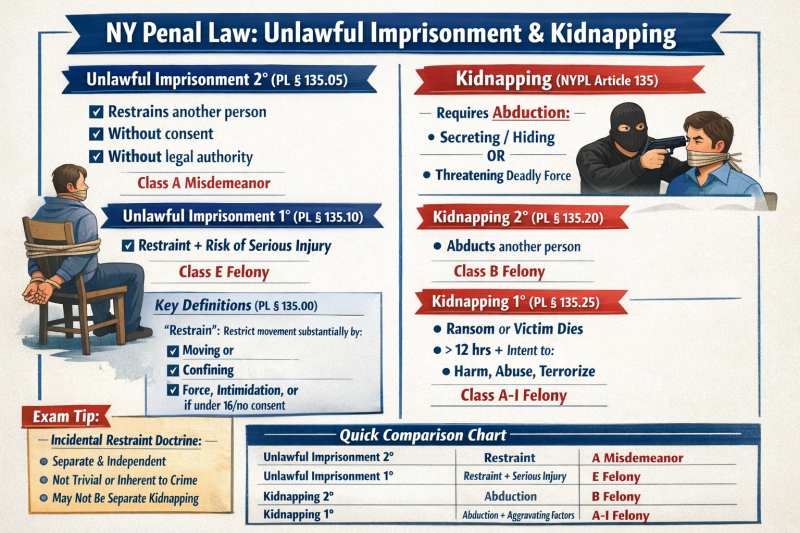
Unlawful imprisonment in the second degree §135.05
A person commits unlawful imprisonment in the second degree when they “restrain” another person. That means intentionally and unlawfully restricting someone’s movement — either by confining them in a place or moving them from one place to another — without legal authority or the person’s consent.
Key Elements
-
Restraining another person is the core element.
-
“Restrain” involves interfering substantially with someone’s liberty by confinement or movement without consent or lawful authority
-
How It Fits into NY Law
-
This offense is a less serious restraint-related crime compared with unlawful imprisonment in the first degree (which includes a risk of serious physical injury and is a felony) and kidnapping (which involves abduction with intent to prevent liberation).
-
It doesn’t require proof of harm beyond the unlawful restraint itself.
-
Unlawful imprisonment in the first degree § 135.10
A person is guilty of unlawful imprisonment in the first degree when they restrain another person in a way that exposes that person to a risk of serious physical injury.
-
“Restrain” means intentionally and unlawfully restricting someone’s movement by confining them or moving them without the person’s consent and without legal authority.
-
“Risk of serious physical injury” means a situation where the restraint creates a substantial risk of death, serious and lasting disfigurement, or prolonged impairment of health or bodily function.
-
Key Distinction from Second Degree
-
The lesser offense, unlawful imprisonment in the second degree (§ 135.05), involves restraining another person without additional risk factors and is a Class A misdemeanor. In contrast, the first degree offense applies only when the restraint creates a risk of serious physical harm.
In short: Unlawful imprisonment in the first degree is a felony that covers situations where someone is intentionally and unlawfully confined or moved in a way that puts them in danger of significant injury.
-
Kidnapping in the second degree NY PL §135.20
Kidnapping in the second degree occurs when a person abducts another person.
-
“Abduct” means restraining someone with the intent to prevent their liberation by either:
-
Secreting or holding them in a place where they are not likely to be found, or
-
Using or threatening deadly physical force against them.
-
-
“Restrain” means intentionally and unlawfully restricting another person’s movements — by moving them or confining them — without consent and with knowledge that the restriction is unlawful.
-
Key Points
-
There is no requirement for ransom, financial motivation, or a long distance move — the essence of the crime is the act of abduction with intent to prevent liberation.
-
The statute focuses on the intent to keep someone from freedom, not just temporary holding.
In short: Kidnapping in the second degree is a serious felony that involves taking and holding someone against their will with the intent to prevent them from being freed.
-
Kidnapping in the first degree NY PL § 135.25
A person is guilty of kidnapping in the first degree when they:
-
Abduct another person with the intent to force a third party to pay money or property as ransom or to make them do (or stop doing) a specific act; or
-
Abduct another person and restrain them for more than 12 hours with the intent to:
-
Inflict physical injury or to sexually violate/abuse the victim;
-
Accomplish or advance the commission of a felony;
-
Terrorize the victim or a third person;
-
Interfere with a governmental or political function;
-
-
Cause the death of the person abducted during the kidnapping or before they can be returned to safety — in such cases, death can be presumed under certain evidentiary circumstances.
-
Key Definitions (Context)
-
Abduct means restraining a person with the intent to prevent their liberation — by hiding or holding them where they are unlikely to be found, or by using or threatening deadly physical force.
-
“Restrain” means intentionally and unlawfully restricting someone’s freedom of movement without consent.
In short: Kidnapping in the first degree involves abduction plus aggravating factors such as ransom demands, prolonged restraint with harmful intent, or the victim’s death, and is punished as a top‑level felony in New York.
-

Coercion in the Second Degree §135.61
Coercion in the 2nd degree occurs when a person intentionally forces or pressures someone to do something—or not do something—by making a wrongful threat.
Key elements:
-
The defendant intends to compel another person’s conduct
-
They do so by making a threat to:
-
Cause physical injury to a person, or
-
Cause damage to property, or
-
Engage in conduct that would harm someone’s reputation (e.g., expose a secret, accuse them of a crime), or
-
Take or withhold action as a public servant in an official capacity, or
-
Perform any other act that would substantially harm the victim’s health, safety, business, career, or relationships
-
-
The threat itself is enough — the threatened harm does not have to occur
Important notes:
-
The threat must be wrongful (i.e., not a lawful demand or legitimate warning)
-
It applies even if the victim doesn’t actually comply
-
Coercion focuses on pressure through threats, not physical force
-
Common examples:
-
Threatening to expose damaging personal information unless someone complies
-
Threatening to harm someone’s property to force payment
-
Using a position of authority to threaten consequences unless demands are met
-
Coercion in the First Degree §135.65
Coercion in the 1st degree is an aggravated form of coercion. It happens when someone commits coercion by making especially serious threats, most notably threats of physical injury, property destruction, or abuse of official power.
Key elements:
-
The defendant intentionally tries to compel another person to act (or not act)
-
They do so by making a wrongful threat to:
-
Cause physical injury to a person, or
-
Cause damage to property, or
-
Use or misuse official authority as a public servant to harm the victim
-
-
The threat alone is sufficient; no compliance or actual harm is required
Important notes:
-
This statute focuses on serious, immediate threats, not minor pressure
-
Applies regardless of whether the victim gives in
-
Often charged when threats are violent or involve official misconduct
-
Common examples:
-
Threatening to physically harm someone unless they comply
-
Threatening to destroy someone’s property to force action
-
A public official threatening misuse of power to compel behavior
-
Custodial Interference in the Second Degree §135.45
Custodial interference in the 2nd degree happens when a person takes, entices, or keeps a child from their lawful custodian without legal right to do so.
Key elements:
-
The child is under 16 years old
-
Another person (usually a parent or guardian) has lawful custody or visitation rights
-
The defendant intentionally interferes with those custody rights
-
This can include removing the child, hiding them, or refusing to return them
Important notes:
-
It can apply to parents, not just strangers, if they violate custody or visitation orders
-
You don’t need force or kidnapping—keeping the child beyond allowed time can be enough
-
A belief that the action was “best for the child” is not automatically a defense
-
Common examples:
-
A parent refuses to return a child after visitation
-
A relative hides a child from the custodial parent
-
Someone takes a child knowing they have no custody rights
-
Custodial Interference in the First Degree §135.50
Custodial interference in the 1st degree is a more serious version of the offense. It occurs when someone commits custodial interference under aggravating circumstances, usually involving removal of a child from New York State or exposing the child to serious risk.
Key elements:
-
The underlying conduct qualifies as custodial interference (unlawfully taking, enticing, or keeping a child from a lawful custodian)
-
One of the following is true:
-
The child is taken outside New York State, or
-
The defendant exposes the child to a risk that endangers their safety or welfare
-
Important notes:
-
Applies even if the person is a parent
-
Crossing state lines is a major trigger for 1st-degree liability
-
Courts look closely at intent, duration, and risk to the child
-
Claiming it was “for the child’s own good” is not automatically a defense
Common examples:
-
A parent takes a child out of New York to block the other parent’s custody rights
-
Hiding a child in another state to avoid a custody order
-
Keeping a child in dangerous or unstable conditions while interfering with custody
Harassment
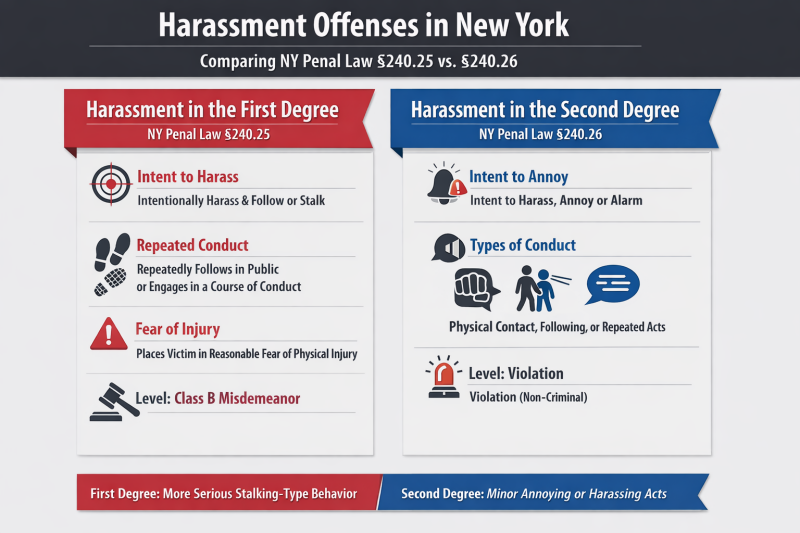
Harassment in the First Degree §240.25
A person commits Harassment in the First Degree when they intentionally and repeatedly harass another person by following them in public or engaging in a course of conduct that places the person in reasonable fear of physical injury.
Key elements:
-
Intent to harass, annoy, or alarm
-
Repeated conduct (not a single incident)
-
Conduct such as following or persistent behavior
-
The conduct places the victim in reasonable fear of physical injury
Level of offense:
-
Class B misdemeanor
In plain English:
This law targets serious, ongoing harassment — essentially stalking-type behavior — that makes someone reasonably afraid they could be physically harmed, even if no injury actually occurs.
Harassment in the Second Degree §240.26
A person commits Harassment in the Second Degree when, with intent to harass, annoy, or alarm another person, they engage in certain low-level misconduct.
The statute covers three main types of conduct:
-
Physical contact or attempts/threats of contact
-
Striking, shoving, kicking, or otherwise subjecting another to physical contact, or attempting or threatening to do so.
-
-
Following someone in public
-
Repeatedly following a person or engaging in conduct that alarms or seriously annoys them and serves no legitimate purpose.
-
-
Course of conduct or repeated acts
-
Engaging in a pattern of behavior that alarms or seriously annoys another person and has no legitimate purpose.
-
Mental state:
-
Intent to harass, annoy, or alarm is required.
Level of offense:
-
Violation (not a crime) — punishable by up to 15 days in jail and/or a fine.
In plain English:
This is the basic harassment offense covering minor physical altercations, persistent annoying behavior, or following someone without a legitimate reason, where the conduct is intentional but not serious enough to rise to stalking or higher charges.
Aggravated Harassment
Aggravated Harassment in the Second Degree §240.30
What it covers:
This statute makes it a crime to intentionally harass, annoy, threaten, or alarm another person through certain types of communications or conduct — especially when there are threats, bias motivation, or repeated unwanted contact.
Key Ways the Offense Can Occur
A person commits aggravated harassment in the second degree when they:
-
📞 Communicate a threat (by phone, text, email, social media, mail, or other electronic means) to cause physical harm or property damage.
-
🔁 Make repeated communications with intent to harass or alarm.
-
🧾 Engage in harassment motivated by bias against protected characteristics (such as race, religion, gender, sexual orientation, disability, etc.).
Mental State Required
-
Must act with intent to harass, annoy, threaten, or alarm — accidental or incidental contact is not enough.
Aggravated Harassment in the First Degree §240.31
What it covers:
This statute makes it a felony to damage property in a way that is intended to harass, annoy, threaten, or alarm, and is motivated by bias against a protected group.
Core Elements
A person is guilty when they:
-
🧱 Damage or deface property (for example, graffiti, symbols, markings, or other physical damage), AND
-
🎯 Act with intent to harass or alarm, AND
-
⚖️ Are motivated by bias against someone’s actual or perceived:
-
Race
-
Color
-
National origin
-
Ancestry
-
Gender
-
Religion or religious practice
-
Age
-
Disability
-
Sexual orientation
-
Mental State
-
Requires intent plus bias motivation — accidental damage or non-bias vandalism does not qualify.

Weapons
Criminal Possession of a Weapon in the Fourth Degree §265.01
What it covers:
This statute makes it a crime to possess certain prohibited weapons or to possess a weapon with intent to use it unlawfully against another.
Main Ways the Offense Can Occur
A person is guilty when they:
Possess Certain Illegal Weapons
Knowingly possess items such as:
-
Switchblade knife
-
Metal knuckles
-
Cane sword
-
Billy/blackjack/bludgeon
-
Metal or plastic knuckle knife
-
Certain disguised or prohibited weapons
Possess a Weapon With Unlawful Intent
-
Possess any dangerous or deadly weapon
-
With intent to use it unlawfully against another person
(Example: carrying a bat or knife intending to assault someone.)
Possess Certain Firearms or Electronic Weapons Unlawfully
Includes unlawful possession of:
-
Firearms without proper authorization (in some circumstances)
-
Electronic stun weapons (subject to evolving case law and regulations)
Mental State
-
Requires knowing possession
-
Plus intent when charged under the unlawful use subsection.
In Plain English
It covers low-level weapon possession offenses, especially possessing banned weapons or carrying something with the intent to use it to hurt someone.
Criminal Possession of a Weapon in the Third Degree
§265.02
What it covers:
This statute elevates weapon possession to a felony when certain aggravating factors are present — such as prior convictions, possession of particularly dangerous weapons, or possession of certain weapons in prohibited ways.
Main Ways the Offense Can Occur
A person is guilty when they:
Possess a Weapon After Certain Prior Convictions
-
Possess a weapon listed under § 265.01
-
After having been convicted of a felony or class A misdemeanor w/in 5 years
Possess Certain Prohibited Weapons
Such as:
-
Machine gun
-
Firearm silencer
-
Assault weapon (as defined by NY law)
-
Large capacity ammunition feeding device (with statutory nuances)
Possess Multiple Firearms
-
Possess three or more firearms
Possess a Defaced Firearm
-
Knowingly possess a firearm with a removed or altered serial number
Mental State
-
Requires knowing possession
-
Prior conviction element must be proven where applicable.
In Plain English
It’s a felony for more serious weapon possession, especially when someone has a criminal history, possesses multiple firearms, or has particularly dangerous or illegal weapons.
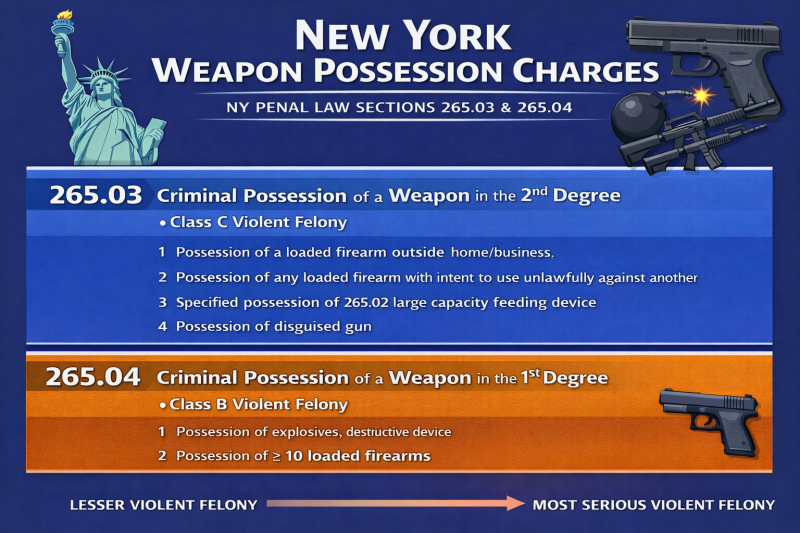
Criminal Possession of a Weapon in the Second Degree
§265.03
What it covers:
This statute makes it a serious violent felony to possess certain firearms — especially loaded firearms — or to possess a firearm with intent to use it unlawfully against another.
Main Ways the Offense Can Occur
A person is guilty when they:
- possess five or more firearms unlawfully
Possess a Loaded Firearm Outside Home or Place of Business
-
Knowingly possess a loaded firearm,
-
Outside their home or place of business (subject to licensing rules and defenses).
Possess a Firearm With Intent to Use It Unlawfully
-
Possess any loaded firearm
-
With intent to use it unlawfully against another person
Possess Certain Weapons as a Previously Convicted Felon
-
Possess a loaded firearm after having a prior felony or serious offense (depending on subsection).
Mental State
-
Requires knowing possession
-
Plus intent where charged under unlawful use subsection.
In Plain English
It targets serious illegal firearm possession, especially carrying a loaded gun or having a gun for violent purposes.
§ 265.04Criminal Possession of a Weapon in the First Degree §265.04
What it covers:
This is the most serious weapon possession charge in New York. It applies when a person possesses multiple illegal firearms under circumstances showing heightened danger.
Core Elements
A person is guilty when they:
- Possess any explosive substance with intent to use unlawfully
-
Possess ten (10) or more firearms, AND
-
The possession is unlawful (no valid authorization or license)
Mental State
-
Requires knowing possession of the firearms.
In Plain English
It targets situations where someone has a large cache of illegal guns, reflecting a high level of risk to public safety.