

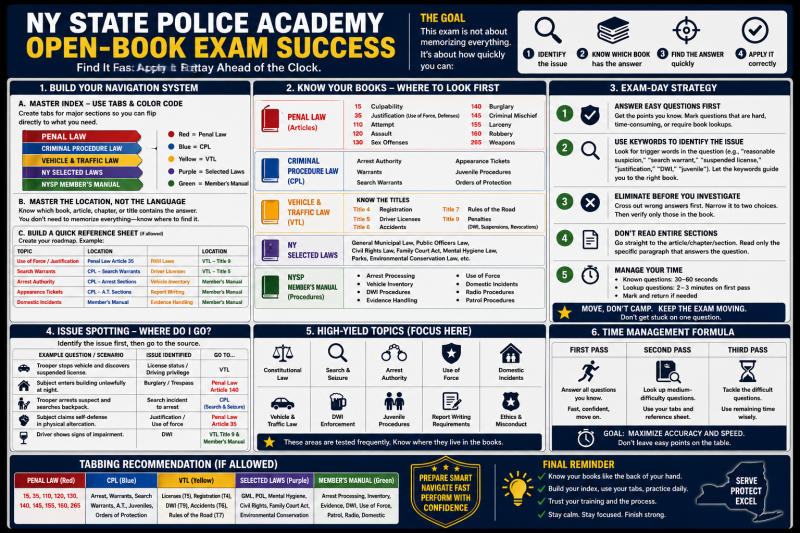
Since you're talking specifically about the New York State Police Academy, I'd approach the open-book exam differently than a typical college exam. The Academy curriculum heavily emphasizes Penal Law, CPL, VTL, Selected Laws, arrest procedures, DWI enforcement, use of force, and NYSP operational procedures.
The Goal: Become Faster Than the Clock
The exam is usually not testing whether you own the books. Everyone does.
It's testing whether you can:
- Identify the legal issue.
- Know which book contains the answer.
- Find the answer quickly.
- Apply it correctly.
Think of it as a legal-reference exercise, not a memorization contest.
Build a "Where Is It?" Mental Map
Penal Law
Memorize the location of major Articles.
High-yield areas:
TopicArticleCulpability15Defenses35Attempt110Assault120Sex Offenses130Burglary140Criminal Mischief145Larceny155Robbery160Weapons265
Instead of memorizing every subsection, know approximately where each article lives in the book.
Example
Question mentions:
- Deadly physical force
- Justification
- Self-defense
Your brain should immediately go:
Penal Law → Article 35
before you even start reading answer choices.
Criminal Procedure Law (CPL)
Many recruits lose time because they know the answer is in the CPL but not where.
Create tabs for:
- Arrest authority
- Warrants
- Search warrants
- Appearance tickets
- Juvenile procedures
- Orders of protection
The CPL is organized by Parts and Articles, so learn the structure first rather than individual sections.
Vehicle & Traffic Law (VTL)
For VTL, don't try to memorize everything.
Know where these titles are located:
TopicAreaRegistrationTitle 4Driver LicensesTitle 5AccidentsTitle 6Rules of the RoadTitle 7PenaltiesTitle 9
Most academy questions tend to revolve around:
- Suspensions
- Revocations
- Equipment violations
- Traffic stops
- DWI
- Accident reporting
These are specifically emphasized in recruit training.
The NYSP Member's Manual Is the Secret Weapon
Most recruits focus on statutes.
The academy often tests:
- Department procedures
- Required forms
- Reporting requirements
- Vehicle inventories
- Arrest processing
- Radio procedures
- Evidence handling
The Member's Manual is often easier to navigate than the law books because the chapters are organized by procedure.
Create Tabs For:
- Arrest Processing
- Vehicle Inventory
- DWI Procedures
- Evidence Handling
- Domestic Incidents
- Radio Procedures
- Use of Force
- Patrol Procedures
Use the "Issue Spotting" Method
When you read a question, identify the issue before opening a book.
Example:
Trooper stops vehicle and discovers suspended license.
Issue:
- License status
Go directly to:
- VTL
Example:
Subject enters building unlawfully.
Issue:
- Burglary or trespass
Go directly to:
- Penal Law Article 140
Example:
Trooper arrests suspect and searches backpack.
Issue:
- Search incident to arrest
Go directly to:
- CPL and search-and-seizure materials
Tab the Books Aggressively (If Allowed)
My recommendation:
Penal Law
Red tabs
- Article 15
- Article 35
- Article 120
- Article 140
- Article 155
- Article 160
- Article 265
CPL
Blue tabs
- Arrest
- Warrants
- Search Warrants
- Appearance Tickets
- Juveniles
VTL
Yellow tabs
- Licenses
- Registration
- DWI
- Accidents
- Rules of the Road
Member's Manual
Green tabs
- Arrest Processing
- Evidence
- Inventory
- Patrol
- Use of Force
Practice the Academy Way
A powerful drill:
- Have someone ask:
- "Where is use of force?"
- "Where is burglary?"
- "Where is appearance ticket authority?"
- "Where is suspended license information?"
- Don't answer the question.
- Answer:
- "Penal Law Article 35."
- "Penal Law Article 140."
- "CPL appearance ticket section."
- "VTL license title."
You're training the skill of locating information.
Exam-Day Rule
Never start reading pages until you've identified:
What book? → What article/chapter? → What section?
The highest-scoring recruits usually know the books' layouts cold. They often aren't looking up more law than everyone else—they're just getting to the correct page in 10 seconds instead of 2 minutes.
For the NYSP Academy specifically, I'd focus most heavily on:
- Penal Law Article 35 (justification/use of force)
- Arrest authority and procedures in CPL
- DWI and license-related VTL sections
- NYSP Member's Manual procedures
- Evidence, vehicle inventory, and arrest processing policies.
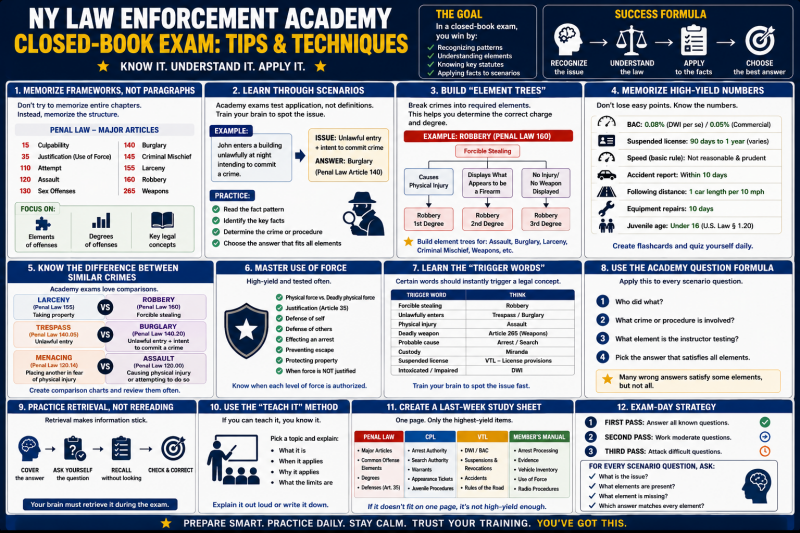
A closed-book NY law enforcement academy exam is a completely different game from an open-book exam.
For open-book tests, you win by finding information fast.
For closed-book tests, you win by:
- Recognizing patterns
- Understanding legal elements
- Knowing key statutes
- Applying facts to scenarios
At academies like the New York State Police Academy, the questions often test whether you can quickly identify the correct charge, procedure, authority, or legal standard under pressure.
1. Memorize Frameworks, Not Paragraphs
Don't try to memorize entire chapters.
Instead memorize:
Penal Law
- Elements of common crimes
- Article numbers for major offenses
- Degrees of offenses
Examples:
- Article 35 = Justification
- Article 120 = Assault
- Article 140 = Burglary
- Article 155 = Larceny
- Article 160 = Robbery
- Article 265 = Weapons
When you know the framework, details become easier to recall.
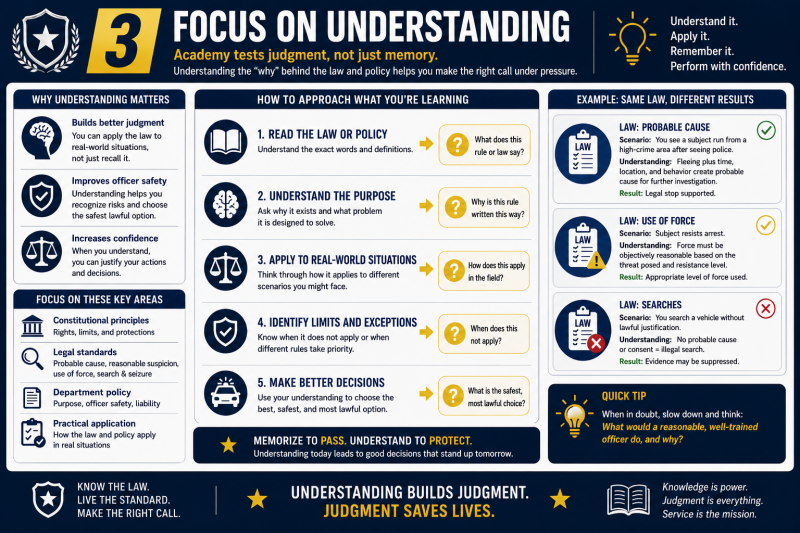
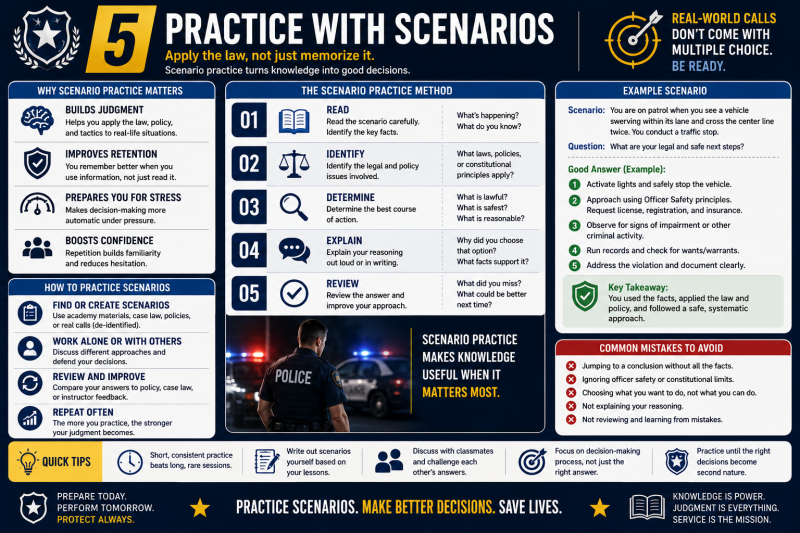
2. Learn Through Scenarios
Academy exams rarely ask:
"What does Penal Law 140.20 say?"
More commonly:
"John enters a building unlawfully at night intending to commit a crime."
Ask yourself:
- Entry?
- Unlawful?
- Intent to commit crime?
Your brain should immediately think:
Burglary.
Train on scenarios rather than definitions.
3. Build "Element Trees"
Example:
Robbery
Must have:
- Forcible stealing
Then ask:
- Physical injury?
- Weapon?
- Display firearm?
This helps determine degree.
Build element trees for:
- Assault
- Burglary
- Robbery
- Larceny
- Criminal Mischief
- Weapons offenses
4. Memorize High-Yield Numbers
Many recruits miss easy points because they forget numbers.
Examples:
- BAC thresholds
- Speed and distance requirements
- Age-related statutes
- Time requirements
- Report deadlines
Create flashcards specifically for numbers.
5. Know the Difference Between Similar Crimes
Academy exams love comparisons.
Larceny vs Robbery
Larceny:
- Taking property
Robbery:
- Forcible stealing
Trespass vs Burglary
Trespass:
- Unlawful entry
Burglary:
- Unlawful entry + intent to commit crime
Menacing vs Assault
Menacing:
- Fear of injury
Assault:
- Actual injury
Create comparison charts.
6. Master Use of Force
This is one of the highest-yield areas.
Know:
- Physical force
- Deadly physical force
- Justification
- Defense of self
- Defense of others
- Arrest situations
Many academy exams revisit these concepts repeatedly.
7. Learn the "Trigger Words"
Certain words should instantly trigger a legal concept.
Trigger WordThinkForcible stealingRobberyUnlawfully entersTrespass/BurglaryPhysical injuryAssaultDeadly weaponArticle 265Probable causeArrest/SearchCustodyMirandaSuspended licenseVTL
The best recruits identify the issue before finishing the question.
8. Use the Academy Question Formula
When reading a scenario:
Step 1
Who did what?
Step 2
What crime or procedure is involved?
Step 3
What element is the instructor testing?
Step 4
Pick the answer that satisfies all elements.
Many wrong answers satisfy some elements but not all.
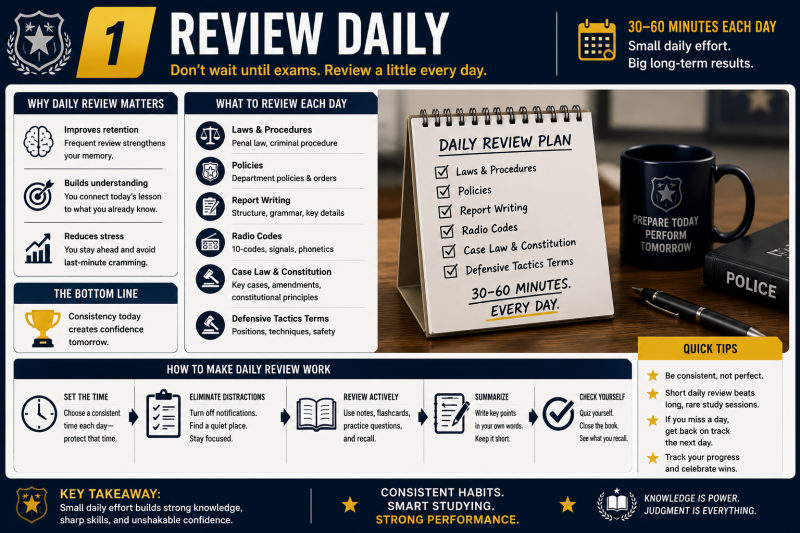
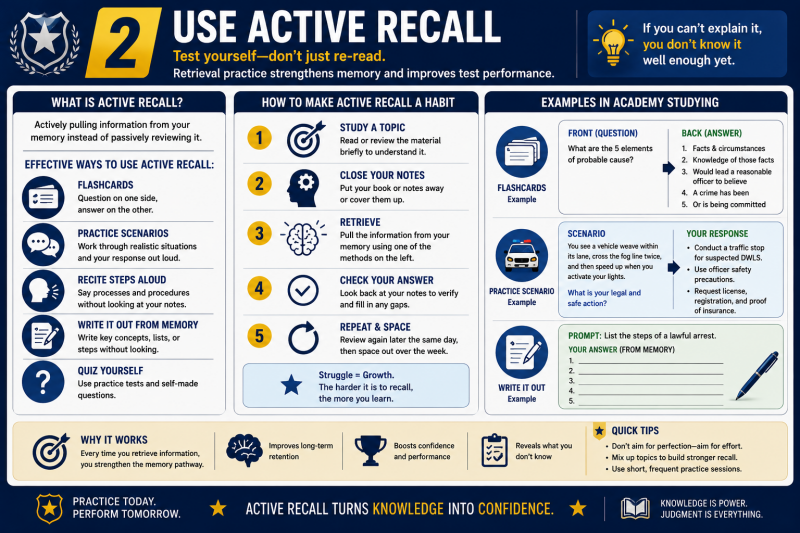
9. Practice Retrieval, Not Rereading
The biggest mistake:
Reading notes repeatedly.
Better method:
Cover the answer and ask:
- What are the elements of robbery?
- What is the difference between burglary and trespass?
- When is deadly force justified?
Force yourself to retrieve information.
This is how academy exams are passed.
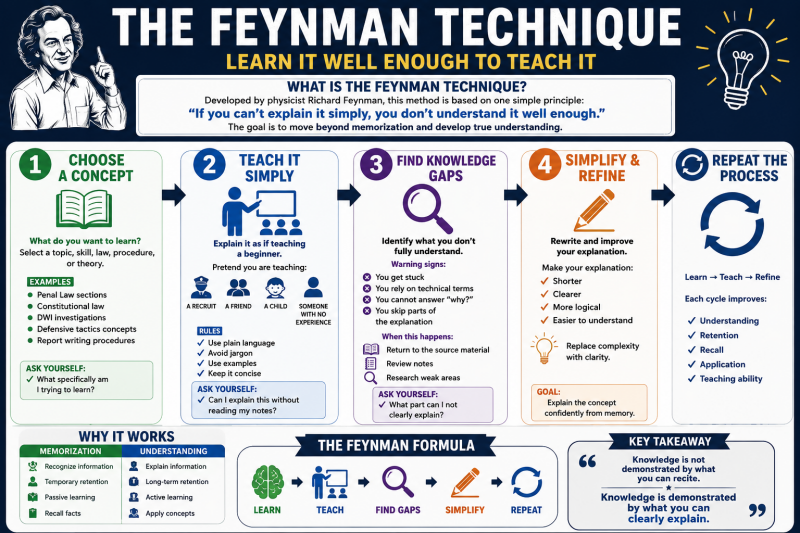
10. Use the "Teach It" Method
If you can teach it, you know it.
Take a topic:
Search Incident to Arrest
Explain:
- When it applies
- Why it applies
- Limits
If you struggle explaining it, you don't know it well enough.
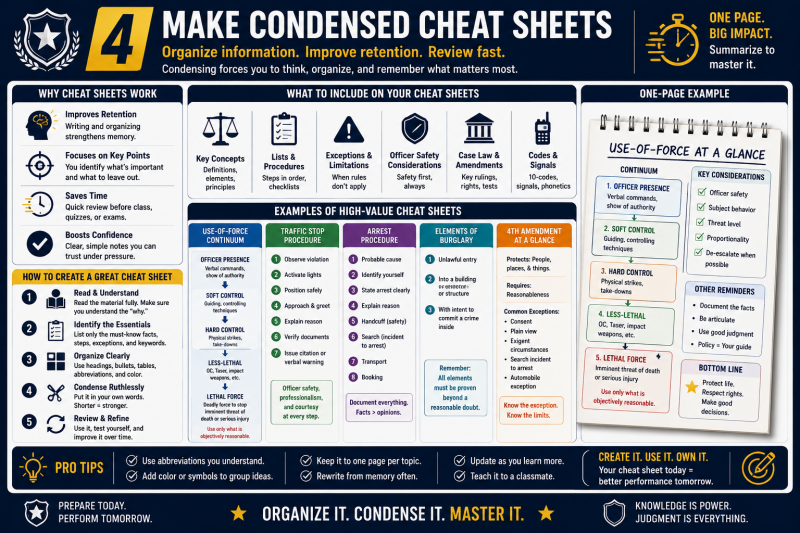
11. Create a Last-Week Study Sheet
Limit yourself to one page.
Include:
Penal Law
- Major articles
- Common offense elements
CPL
- Arrest authority
- Search authority
- Warrants
VTL
- DWI
- Suspensions
- Accident reporting
Member's Manual
- Arrest processing
- Evidence
- Vehicle inventory
- Use of force
If it doesn't fit on one page, it's probably not high-yield enough for final review.
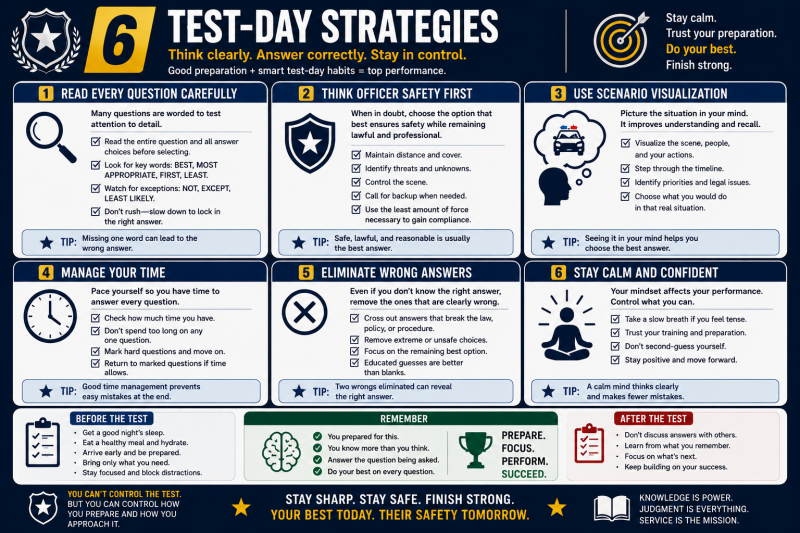
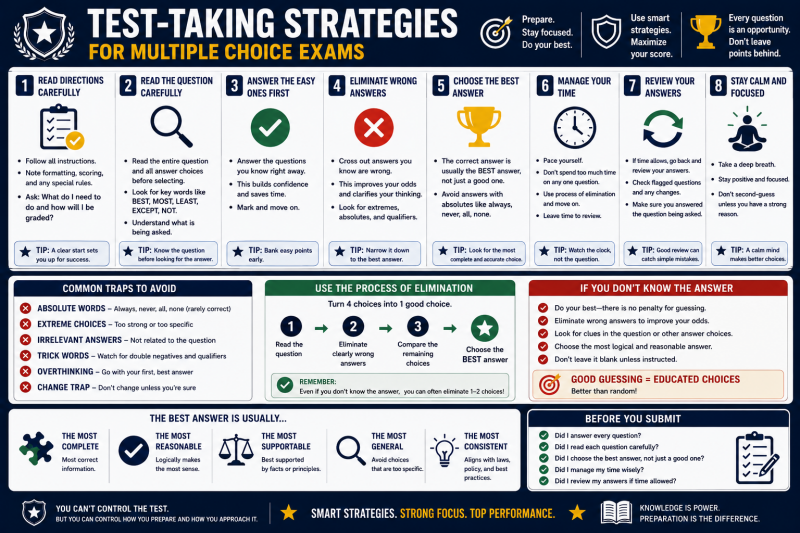
Exam-Day Strategy
First Pass
Answer immediately known questions.
Second Pass
Work moderate questions.
Third Pass
Attack difficult questions.
For Every Scenario Question
Ask:
- What is the issue?
- What elements are present?
- What element is missing?
- Which answer matches every element?
The recruits who score highest on NY law enforcement academy closed-book exams typically aren't the ones who spend the most hours reading. They're the ones who repeatedly practice identifying legal elements, applying them to scenarios, and recalling information without looking at notes. That's exactly what you'll be doing in the field when you have to make decisions without a book in front of you.